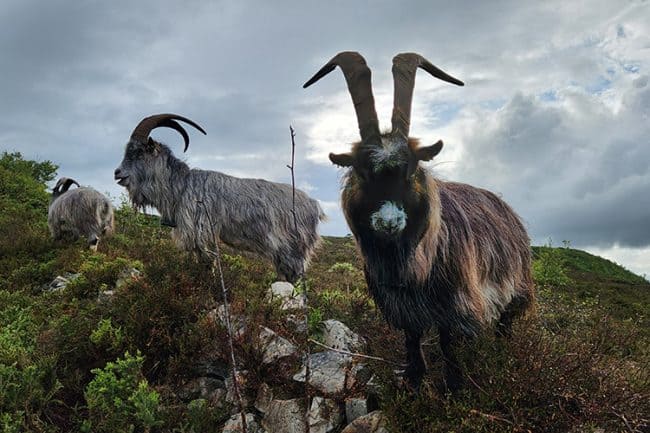
The Old Irish Goat has been confirmed as one of Ireland’s oldest surviving livestock lineages.
Research led by University College Dublin, in collaboration with Queen’s University Belfast and international partners saw a new biomolecular and archaeological study of this species published in the Journal of Archaeological Science.
The study findings reshapes the understanding of Ireland’s agricultural past and supports conservation of the Old Irish Goat as a living link to ancient farming communities.
Goat Link to Bronze Age Ireland
Scientists from University College Dublin and Queen’s University Belfast analysed bone fragments recovered from two archaeological sites: Haughey’s Fort in Co Armagh, dating to around 1100–900 BCE, and medieval Carrickfergus in Co Antrim.
Using radiocarbon dating, protein analysis, and ancient DNA sequencing, they identified the remains as the oldest goats ever recorded in Ireland. When the ancient genomes were compared with modern breeds, researchers found the strongest match with the Old Irish Goat, a critically endangered breed that survives today in small feral herds. The findings indicate an unbroken genetic lineage from Ireland’s Late Bronze Age farming communities to the present day.
Dr Jolíyn Erven, co-lead author the study, said, “Despite thousands of years, changing farming practices, and recent decline, these goats have retained a remarkable genetic connection to their ancestors, and to the island’s agricultural past.”
“Goats tend to get overlooked compared to sheep in the archaeological record because it is notoriously difficult to distinguish between their bones. There is an assumption that sheep would have been more important than goats in the past but historical sources suggest that herds of goats may have been kept to supply a trade in skins from ports such as Carrickfergus,” said co-lead author Professor Eileen Murphy, Queen’s University Belfast.
Studying ancient DNA
To identify definite goats, the team first had to use protein fingerprinting (ZooMS), a technique that identifies species through microscopic traces of preserved collagen. Ancient DNA was then extracted and sequenced, allowing researchers to compare the genomes of these Late Bronze Age and medieval animals with hundreds of modern goat breeds worldwide.
The study found that both prehistoric and medieval Irish goats share their highest genetic affinity with the still surviving Old Irish Goat, pointing to a remarkable continuity of goat populations on the island over three millennia.
While the study confirms the breed’s ancient origins, it also reveals signs of recent inbreeding, linked to a sharp decline in population over the past century.
Researchers say this underscores the urgency of conservation efforts to protect a lineage that has survived for millennia but now faces modern threats.
The discovery offers new insights into early Irish agriculture and demonstrates the value of biomolecular techniques in uncovering long-term continuity in livestock populations.
For conservationists and historians alike, the Old Irish Goat now stands as a living archive of Ireland’s rural past.
Read: Old goats: 3,000 years of genetic connectivity of the domestic goat in Ireland
https://www.sciencedirect.com/science/article/pii/S0305440326000464
Visit: Old Irish Goat
Home – Old irish goat home
Get in Touch
If you have a tip for an animal welfare issue, an animal news article, a press release, or just want to just reach out to us, we’d love to hear from you. John Tierney, Animal News Ireland/Editor