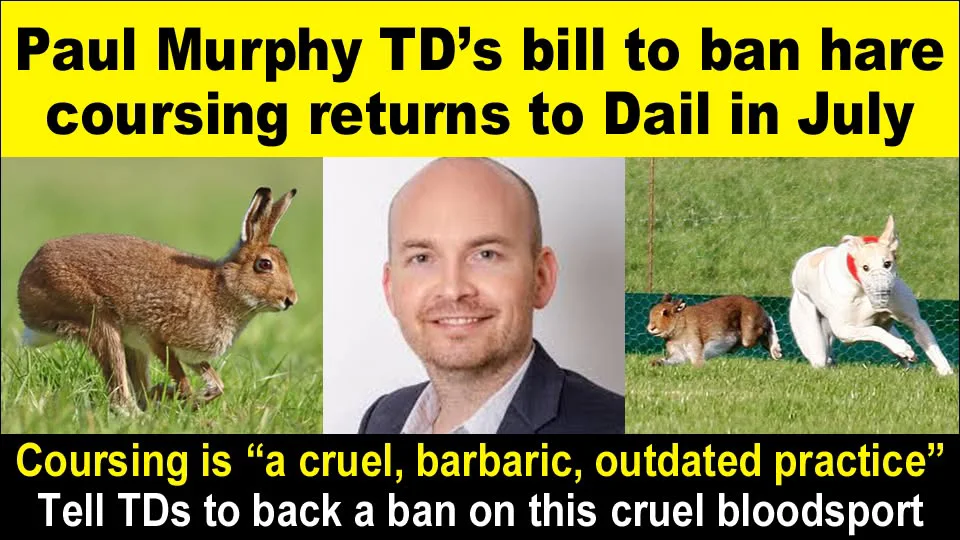
Paul Murphy TD’s bill to ban hare coursing is due to return to Dáil Éireann next month, six years after it was introduced.
The Animal Health & Welfare (Ban on Hare Coursing) Bill 2020, which aims to finally bring cruel hare coursing to an end in Ireland, will be back on 2nd July 2026 for Second Stage debate and vote.
The bill – which was co-signed by Richard Boyd Barrett TD and then TDs Gino Kenny, Mick Barry, Brid Smith, Joan Collins and Catherine Connolly – was first introduced on 16 September 2020.
At the time, Deputy Murphy condemned coursing as “a cruel, barbaric and outdated practice”.
“It has been banned across Britain and Northern Ireland and across the entire EU, apart from three countries, including Ireland,” he stated.
Ban Hare Coursing
Most people in Ireland want this cruel bloodsport banned – as confirmed repeatedly by opinion polls over the years.
Campaigners against this bloodsport have said that coursing causes huge disturbance to the Irish hare species.
Each year thousands of hares are netted from the wild and forced to run for their lives suffer fear and stress.
This ordeal compromises the welfare of all of the hares and negatively impacts their subsequent chances of survival. The stress-related illness, capture myopathy, can claim the lives of hares in the days and weeks after coursing has concluded.
During the six month coursing season, hares who are caught and pinned to the ground during coursing meetings suffer injuries so severe, they die or are euthanised by coursing club vets.
The muzzling of greyhounds at enclosed coursing meetings was introduced at the start of the 1993/94 hare coursing season. It was brought in on a phased basis. By the end of the 1993/94 season all courses at enclosed coursing meetings involved muzzled greyhounds. This includes the trials, which are held before an enclosed meeting.
Muzzling of greyhounds does not apply to open hare coursing meetings.
ICABS Support Live Hare Coursing Bill
The Irish Council Against Blood Sports (ICABS) in a submission to TDs highlighted the suffering and death in coursing and fears for the future of this iconic species in the midst of a government-declared biodiversity emergency.
ICABS said that the Irish hare must be protected, not persecuted, and it is finally time for a ban on live hare coursing.
The organisation will be stepping up its anti-hare coursing campaign in advance of the Dáil debate on this issue.
It is calling on its supporters and those with are interested in wildlife protection to contact their local TDs, and urge them to support the Animal Health & Welfare (Ban on Hare Coursing) Bill 2020 which aims to end the annual abuse of the Irish hare
Live Hare Coursing in Ireland:
The Greyhound Industry Act 1958.
This is the primary legislation that governs the control and operation of live hare coursing.
https://www.irishstatutebook.ie/eli/1958/act/12/enacted/en/index.html
The Wildlife Act 1976 (and amendments)
The Irish hare is protected from being hunted, killed, or captured, a permit is required to net, capture, and course hares.
https://www.irishstatutebook.ie/eli/1976/act/39/enacted/en/index.html
Animal Health and Welfare Act 2013
Primary legislation sets animal cruelty laws in Ireland. Hare coursing has an exemption under this legislation, however, while lawfully coursing a hare, the hare is hunted or coursed in a space from which it does not have a reasonable chance of escape, this is considered an offence under Section 12 of the Animal Health and Welfare Act 2013 (Prohibition on Animal Cruelty).
https://www.irishstatutebook.ie/eli/2013/act/15/section/12/enacted/en/index.html
Get in Touch
If you have a tip for an animal welfare issue, an animal news article, a press release, or just want to just reach out to us, we’d love to hear from you. John Tierney, Animal News Ireland/Editor
Support Animal Journalism
Dear reader: If you support animal journalism and its work to highlight animal issues, please consider donating to Animal News Ireland. You can give any amount one time, or make it a monthly gift, as many of our supporters do. Thank you for helping us in our work to be the voice of the voiceless.