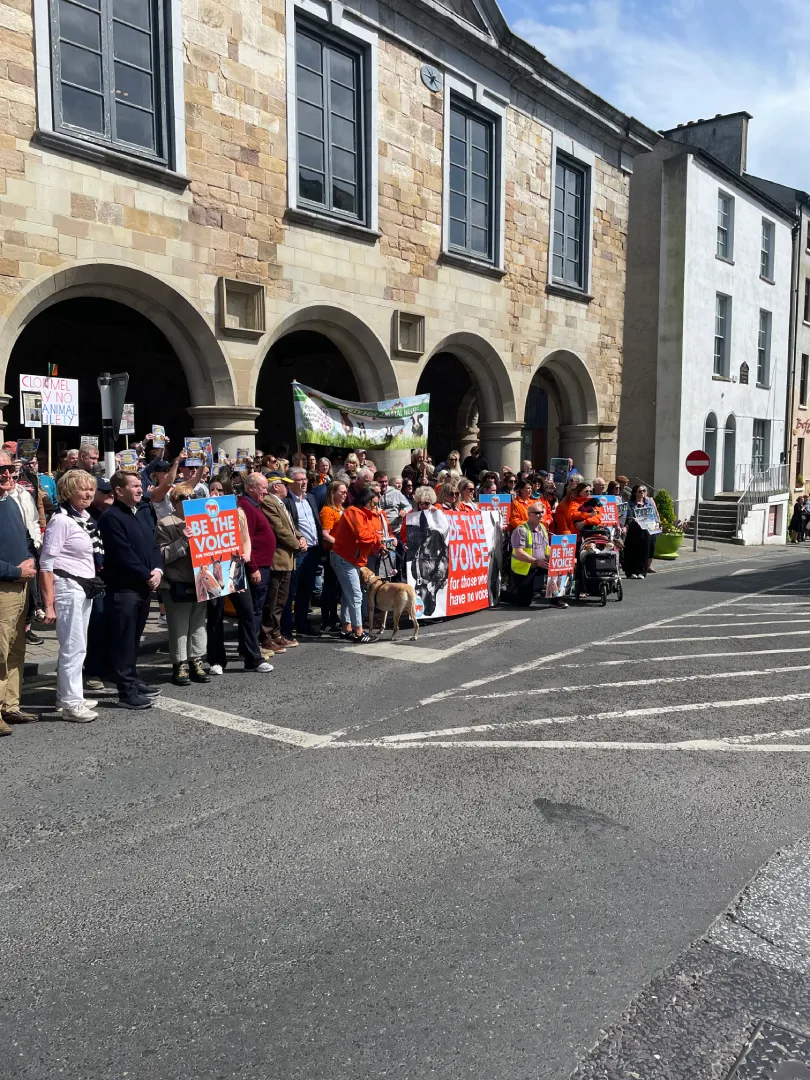
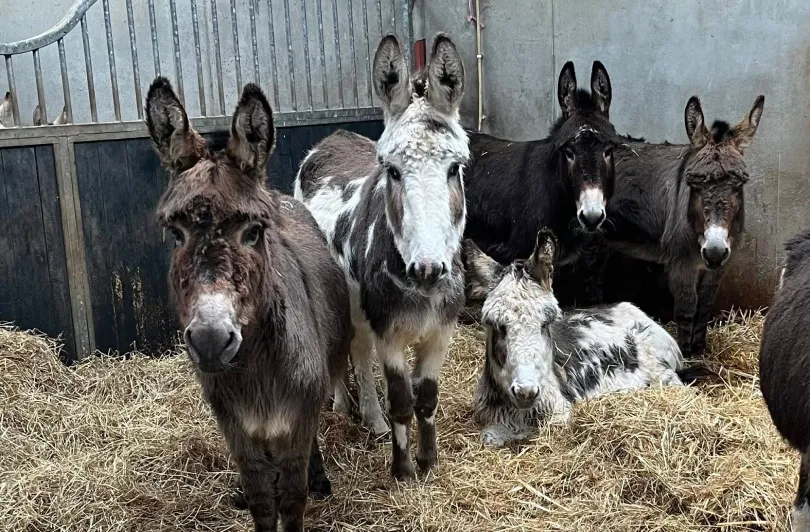
Sixteen complaints have been made to DAFM’s Animal Welfare Hotline in respect of a recent DAFM enforcement operation.
The complaints arose following the release of a video of a DAFM enforcement operation on a Co. Roscommon farm. The farm owner is currently involved in a long running animal welfare case with DAFM.
The footage shows cattle allegedly being penned into small tight spaces and being killed in front of other animals in extremely close proximity. It also allegedly shows animal carcasses in the same penned area of a yard where living animals are present.
DAFM have confirmed that an enforcement operation at the Co. Roscommon farm did take place in July, and it was conducted in accordance with established department processes and where appropriate with the support and assistance of An Garda Síochána.
Animal welfare organisations and farming organisations have expressed concern at about the video content and have called for an independent review of how DAMF enforcement operations are conducted.
–
Inland Fisheries Ireland (IFI), in conjunction with other government agencies, is investigating a significant fish kill at Cavan town river.
IFI officers received details of a fish kill on the river late on Tuesday night and attended onsite early Wednesday morning.
IFI officers have observed significant numbers of dead trout, coarse fish and eels over a 2-km stretch of the river. Early indications suggest more than 4,500 fish have died.
Species of fish discovered dead include brown trout, European eel, roach, lamprey and minnow, as well as freshwater crayfish.
IFI is working with other government agencies in line with the national interagency protocol for investigating significant fish kills, and is the lead agency on this case.
An interagency group met online today to coordinate the ongoing investigation, and included representatives from Cavan County Council, the EPA, the Marine Institute, and the National Parks and Wildlife Service.
The interagency group is actively probing the cause of this harmful ecological event, but it’s too early to definitively establish the cause.
–
An illegal salmon poaching operation in south-west Donegal has been uncovered by Inland Fisheries Ireland officials.
The IFI investigation was conducted at Teeling Bay, west of Killybegs, Co. Donegal.
It was reported that a net had been set across Teelin Bay, preventing salmon from migrating up the River Glen to their spawning ground.
Twelve salmon were recovered alongside a dingy and net. but no arrests were made.
Illegal fishing can be reported to Inland Fisheries Ireland’s confidential 24/7 report line 0818 34 74 24. Visit: https://www.fisheriesireland.ie/
–
Bernard Jackman (40) of Munny Upper, Coolkenno, Carlow was sentenced to ten months in prison, suspended for 24 months, with a €300 own bond, and banned from ever owning animals again.
An order was made for Mr Jackman to surrender any dogs under his control to the state.
At Carlow District Court, Judge Geraldine Carthy also ordered Mr Jackman to pay a class A fine, the prosecution’s costs, which come to €3,000, to be paid within 120 days, as well as the rest of the NSPCA’s costs in looking after the dogs removed from his care, which amounted to €13,059.43.
The court was told that €6,100 has been paid. The remaining amount is to be paid within 12 weeks or Mr Jackman will be re-entered in court to activate his sentence.
The case came about following a report to the National Society for the Prevention of Cruelty to Animals/NSPCA who were contacted by a member of the public over concerns about the welfare of 20 dogs living on a farm at Munny Upper, Coolkenno, Shillelagh, Co Wicklow that Mr Jackman owns.
An NSPCA inspector discovered dogs in poor conditions in kennels that were filthy with dog faeces and pools of urine on the floor. Many of the dogs had untreated skin conditions, infections and wounds. Also, a number of dogs had their tail docked.
Mr Jackman denied he was an illegal dog breeder.
Judge Carthy said the facts of the case and the photographs of the dogs and the conditions they were being kept made this one of the worsst cases I have come across on the bench.
–
A Co. Wexford councillor has said the person responsible for dumping a dead goat on a rural Wexford road should serve jail time.
Paddy Kavanagh, independent councillor, told a meeting of Wexford County Council/WCC that while our walking recently he came across a dead goat wrapped in a black sheet. He outlined, “Last week I came across a black sheet left on the side of the road with something wrapped up inside it. I pulled it back to see what was there and it was a dead goat. It was horrendous.
“I had to ring council staff to come out to that and I have to say they’re not paid enough to do that kind of work. They in turn had to ring the knackery to deal with it – so there was extra expense to the taxpayer.”
Cllr. Kavanagh said existing fines for dumping are too low and called for the fine to be increased to €1000 with jail time in the most severe cases. From September 1, those found guilty of illegal dumping will be fined €250, an increase on the existing figure of €150.
In response, he said, “This increase doesn’t even take into account inflation. It’s not a deterrent,” he said. “Someone can dump a dead goat and, if they are caught, get away with a €250 fine. They should be locked up in jail.”
– credit: Official FB Page My Lovely Horse Animal Rescue – ref: Cllr Michael Brennan, Tipperary
A dead horse has been found floating in the River Suir near Clonmel, Co. Tipperary, Tuesday, July 21.
The horse’s body was in the water at a location on the river known as Careys Slip. A local river rescue group moved the animal to a location downstream where it was removed from the water by workers from Tipperary County Council, Wednesday, July 22. A local knackery service took the horse away for disposal. A scan for a microchip was conducted but no microchip was detected.
Local independent councillor, Michael Brennan, highlighted the incident He said, “This is a horrifying thing – it’s an issue that we’ve been highlighting for a number of months in the County Council, to the public, we’ve had our march.”
He made a plea to the person responsible for the horse to come forward and explain what happened to the animal and how it ended up in the water.
Cllr. Brennan said, ““This will be the straw that will break the camel’s back – it puts Tipperary again in the forefront of animal cruelty and we are turning a blind eye to it.”
He called up the Mayor of Clonmel to make a statement on the issue and said previous holders of the Mayor’s office has failed in their duty to speak up for the non-humans of Clonmel.
Mr Brennan has highlighted local animal welfare issues in Co. Tipperary including the racing of horses and ponies on public roads.
–
In response to issues raised by a recent enforcement operation by the Department of Agriculture, Food and the Marine/DAFM on a farm in Co. Roscommon, a meeting was held being Irish Farmers Association/IFA, representatives and DAFM officials with responsibility for farm animal welfare and investigations.
The IFA has expressed concerns about how the DAFM operation was conducted in respect of animal welfare.
Following the meeting, an IFA spokesperson expressed the view that DAFM officials working on the ground dealing with farm animal welfare issues are not been given guidance on the conduct of enforcement operations, and are not being provided with the resources or equipment to do their work.
DAMF are to issue an official response on the matter with the next few days.
The IFA is now seeking a meeting of the Farm Animal Welfare Advisory Council/FAWAC to discuss the matter.
–
An estate agent and a contract worker who were involved in the destruction of a house martin colony on a property that was for sale have been ordered to donate €10,000 to charity.
Hazel Lindsay of Knock Road, Roscrea, Co Tipperary and Gerard Bracken (63) of 28 Rockview Drive, Portlaoise, Co. Laois, both pleaded guilty to causing injury to protected birds and also to the wilful destruction of wild bird nests at Cullenagh, Laois in July of 2025.
Portlaoise District Court, Co. Laois, was told that horse that was being sold and Ms Lindsay worked for the estate agent, Clement Herron Real Estate, had directed the works in order to prepare the house for sale for the owner who lived abroad. This involved the power washing of the property building.
A conservation ranger at the National Parks and Wildlife Service (NPWS) said the NPWS received a complaint on July 25 stating that House Martin nests had been destroyed at a house in Cullenagh.
The ranger said photographs of the scene were taken which showed the nests belonged to House Martins. Birds’ eggs were smashed and there were pictures of dead House Martin chicks.
He said these birds were an Amber listed species, meaning they are of conservation concern as their numbers are dropping.
He said a number of nests were destroyed and they had been “blasted off a wall”. It was estimated that 57 nests were destroyed and that up to 205 birds were killed.
Judge Andrew Cody agreed that the matter was appalling and he noted that it was done for financial gain.
“What was done here was for profit…clear them all out of the way because they are pooping all over the patio,” he said.
Judge Cody adjourned the matter back to Portlaoise District Court, Co. Laois on September 18 next. He indicated that Ms Lindsay should bring €8,000 and Mr Bracken should bring €2,000. It is understood that Wildlife Rehabilitation Ireland will be the beneficiary of these monies.
Judge Andrew Cody said he would apply the probation act subject to the payment of the money.
–
The Irish Council Against Blood Sports/ICABS have analysed the recent vote taken on Paul Murphy TD’s Animal Health & Welfare (Ban on Hare Coursing) Bill, in the Dáil on the 8th of July.
125 TD’s voted against the bill drawn from the parties of Fianna Fáil, Fine Gael, Sinn Féin, Independent Ireland and Aontu.
The analysis showed:
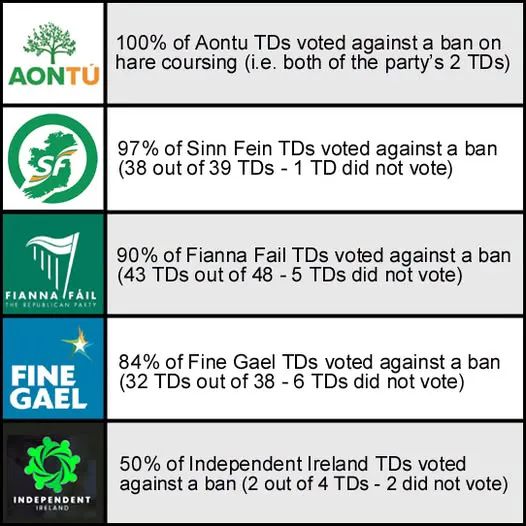 credit: ICABS FB – Hare Coursing Vote – 8h July 2026
–
The Department of Agriculture, Food, and the Marine (DAFM) has reported that DAFM officials, assisted by the Gardaí, recently carried out an ‘enforcement operation’ on a farm in Co. Roscommon.
The operation took place as a result of animal welfare concerns at the farm and it involved the euthanizing of a large number of cows.
DAFM has lead policy responsibility for animal welfare and any neglect of or causing unnecessary suffering to animals is not acceptable. Reports of incidents of animal cruelty or neglect can be reported to its confidential helpline, on 01 607 2379.
–
Cuan Prendergast (43) of The Ridge, Old Leighlin, Co Carlow pleaded guilty to five charges brought by the Department of Agriculture following an investigation by the National Society for the Prevention of Cruelty to Animals (NSPCA).
The case involved the neglect of a dog named Ruby.
The court was told by NSPCA Inspector Fiona Conlon that on the 25th June 2025, a vet visited Mr Prendergast property at Old Ridge Road at Old Leighlin, Carlow following a complaint of a dog in poor condition.
The vet found a dog in a severe state of neglect. The dog was “crawling in maggots” and was also emaciated, with an ulcer on the right side of her head and holes in her head and legs caused by maggot infestation.
It was decided on animal welfare grounds that the dog be euthanised.
Ms Conlon called to the property on foot of the identification of the dog’s registered address via a microchip. Mr Prendergast told her that Ruby has run away some time ago and had not been seen since. She did not believe this version of events.
Photographs of Ruby in her neglected state were shown Judge Miriam Walsh. She said, “My stomach is turning from seeing these pictures – I have never seen this before. I can’t even tell what part of the body that is.”
Judge Walsh imposed two separate fines of €750, to be paid within three months, and imposed a lifetime disqualification order, banning Mr Prendergast from owning or keeping any animals. The fourth summons, relating to the section 13 offence for the provision of suitable and wholesome food, was struck out, while another summons was taken into consideration.
–
Wildlife Rescue Cork (WRC) has announced its very first biodiversity conference, The Wild Assembly: Wings, Whiskers and Waves, due to be held at UCC Cork city on Saturday, November 21st, 2026.
The WRC conference is bringing experts from across Cork and beyond for a day dedicated to celebrating and protecting the region’s wildlife this winter. Talks will be given by speakers who are working across biodiversity and conservation projects.
The full programme of events and speakers will be announced shortly but already confirmed are sessions focusing on swifts, barn owls, as well as representatives from the National Parks and Wildlife Service (NPWS), Cork City Council, and Cork County Council.
The event will also be officially opened by Cork senator Laura Harmon and who also will deliver the opening address to conference delegates.
Wildlife Rescue Cork
Working to rescue and rehabilitate wildlife from their base in Whitechurch, Co. Cork
View/Donate: Wildlife Rescue Cork
https://wildliferescuecork.com/
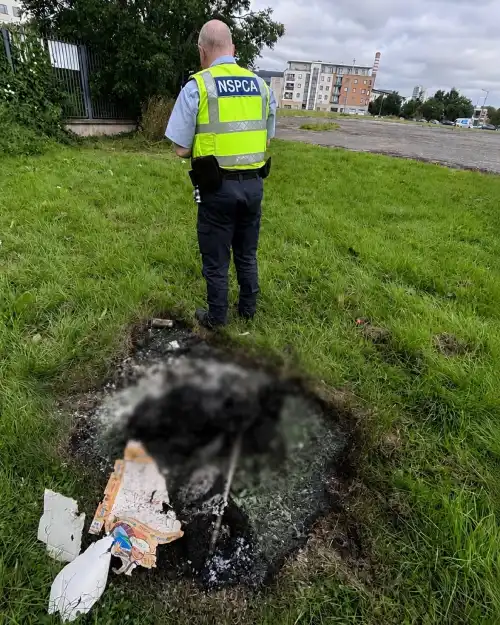
The NSPCA have highlighted an incident in Dublin in which a dead dog was found in a burnt-out wheelie bin.
Last Thursday, NSPCA inspector responded to a call in Ballymun, Dublin 11. They found the remains of the dog, believed to be a brindle Staffie type, in a burnt patch of ground. According to the NSPCA, the remains were so badly damaged that identification was not possible.
Inspectors also discovered what appeared to be a stick or pole lodged in the dog’s body. It is believed that this pole was part of the wheelie bin.
The NSPCA is actively investigating this incident. It is appealing to anyone who may have seen or heard anything that could assist enquiries, no matter how insignificant it may seem. All information reported to the NSPCA will be treated in the strictest confidence.
Ballymun Gardaí are also investigating the matter and have appealed for information on the matter that would assist their investigation.
Visit: National Society for the Prevention of Cruelty to Animals-NSPCA
Home Page – NSPCA
–
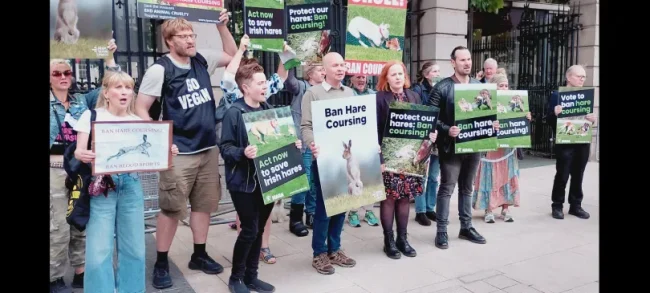 credit: ICABS FB – Anti-Hare Coursing Protest Dáil – 2nd July
Animal welfare activists held an anti-hare coursing protest outside Dáil Eireann yesterday. Paul Murphy TD and Ruth Coppinger TD joined a large number of protesters who called for a ban on live hare coursing.
A Dáil debate on Paul Murphy TD’s Animal Health & Welfare (Ban on Hare Coursing) Bill was held later that evening. ). A vote on the bill will take place on Wednesday, 8th July.
A massive lobbying campaign of TDs has be launched by animal welfare organisations as part of the campaign to finally ban live hare coursing in Ireland.
The Ban on Hare Coursing Bill aims to ban hare coursing in Ireland, which would be in line with already existing bans in Northern Ireland and many European countries.
–
-end
Thank you for reading our animal news articles.
Bookmark: www.animalnewsireland.com
Don’t forget to tell your tribe about our website, animalnewsireland.com, Ireland’s source for animal-related news.
Eleanor is home. My Lovely Horse Rescue has reported that Eleanor, the pony that was stolen from their sanctuary, has been located and returned to the care of MLHR. A FB post/26th June gave details of Eleanor’s safe return:
SHE’S HOME, ELEANOR IS HOME There are no words big enough for what we are feeling tonight. For 28 long days, we searched. We hoped. We cried. We prayed. We refused to give up. There were moments when our hearts were breaking, but one thing never changed, we were never going to stop looking for our beautiful little Eleanor.
Today, everything changed.
A person contacted us and said they thought they knew where she was. After so many false leads, we had to be careful, so we asked this person to send us a video with today’s newspaper. When we saw it, our hearts began to race
We drove to Clondalkin, hardly daring to believe it. Hidden behind bushes, tied on a long blue rope… there she was, Kishoge, Clondalkin [Co. Dublin]/ Our Eleanor.
The moment we saw her, the tears came. Tears of relief. Tears of joy. Tears we have been holding back for 28 days. We wrapped our arms around her and could hardly believe she was finally back where she belongs.
To every single person who shared her story, kept an eye out, sent messages, offered support, said a prayer, or simply refused to forget about her… thank you. You carried us through some very dark days.
We will never be able to express how grateful we are for the love you showed Eleanor and all of us at My Lovely Horse Animal Rescue to whoever thought they could take her from us, know this, you didn’t win. We got her back. No reward. We never gave up, and we never will. We will always fight for our animals, no matter how long it takes
Tonight, Eleanor is safe. She’s surrounded by the people who love her. She is home. From the bottom of our hearts, thank you for believing with us, searching with us, and never letting Eleanor be forgotten.
Welcome home, our beautiful girl. You have no idea how loved you are.
View: My Lovely Horse Rescue https://www.facebook.com/MyLovelyHorseRescue
–
The NSPCA have highlighted a recent creative kitten rescue in Co. Waterford. Writing on the FB page: 24th June 2026A Mother’s Call Saved Him
In Dungarvan, Co. Waterford, two kind hearted women tried for several hours to rescue this tiny, 5 week old kitten from the bonnet of a car. He was so terrified that every attempt only caused him to retreat further into the engine. NSPCA Inspector Alice arrived armed with tasty cat food to lure him out. After several unsuccessful attempts, she placed her phone underneath the car and played a YouTube video of a mother cat calling her kittens.
A few minutes later, he peeked his tiny head out from beneath the under carriage answering the calls and started to make his way towards the phone. As soon as his tiny paws touched the ground, Inspector Alice grabbed him before he was ready to bolt once again. The little kitten is now safe and although he is without his mother he is loved and will have a home to call his own soon. Thank you to the two ladies who tried to rescue him and for getting in touch with the NSPCA Waterford for help.
–
A report into the slaughter of cattle, sheep, and pigs in Ireland covering the first five months of 2026 has revealed that 683,896 cattle, 962, 00 sheep and 1.5m pigs were killed at Irish meat factories and abattoirs.
The Livestock Slaughterings May 2026 report published today (Wednesday, June 24) by the Central Statistics Office (CSO) gives a factual insight into the number of farm animals killed for Ireland’s meat and meat by-products industry.
–
A Cork man had a number of charges relating to illegal hunting dismissed at a recent sitting of Macroom, Co. Cork district court.
DJ O’Driscoll, aged 29, of Lower Codrum, Macroom, Co Cork, was charged with unlawful hunting or entry on land and failing to keep a dog under control in public, as well as not wearing a seatbelt.
The case concerned an incident Wood Road, Carriganine, Macroom, Co Cork, on July 23, 2024. Gardaí attended the scene following a complaint from a landowner regarding three men trespassing with dogs. Mr O’ Driscoll told Gardaí that he had permission from one landowner to hunt but not from the neighbouring landowner.
His dog had strayed onto the neighbouring land and he had gone after it. The landowner confirmed that Mr O’ Driscoll and two other men had no permission t0 be on the land.
Judge Andrew Cody heard from the defendant’s solicitor that his client was receiving treatment for alcohol addiction, and that Mr O’ Driscoll was taking steps to turn his life around.
In light of this, Judge Cody dismissed the three charges subject to the consent of the Director of Public Prosecutions (DPP). Mr O’ Driscoll was ordered to make a donation of €1,000 to the Cork Society for the Prevention of Cruelty to Animals by July 15, 2026.
–
The Irish Council Against Bloodsports (ICABS) are calling on the Minister for Agriculture, Martin Heydon, to intervene to stop horse racing and greyhound racing during a predicated heatwave this week.
A ICABS spokesperson said, ““We are appealing to the Minister to call off horse and greyhound racing during these very hot days, which we strongly contend would compromise the welfare of the horses and greyhounds if they were forced to race, risking heat stress, heat stroke and even death.”
Met Éireann have issued a weather warning, valid: 12:00 Tuesday 23/06/2026 to 09:00 Friday 26/06/2026 based on: Maximum temperatures in excess of 27°C combined with night-time minima in excess of 15°C expected.
–
The 2025 Annual Implementation Report for the Hen Harrier Threat Response Plan has been published.
This first report highlights progress on actions by public authorities to reverse the decline of Hen Harrier and improve its long-term prospects during the first year of the Threat Response Plan.
The Hen Harrier is a rare bird of prey that breeds in open upland bog and heather moorland. It has seen significant declines in recent years, and the Hen Harrier Threat Response Plan includes actions to address key threats and pressures arising from land use change.
It includes measures across agriculture, forestry and wind energy development sectors, both inside and outside the Hen Harrier Special Protection Areas (SPAs).
Minister of State for Nature, Heritage and Biodiversity Christopher O’Sullivan TD, said, “Reversing the decline of the Skydancer is challenging given the specific pressures it faces. Habitat restoration is key, and the NPWS has been working closely with the Department of Agriculture, Food and the Marine, Coillte and the farming community to step up efforts to improve the habitat for this magnificent bird of prey.”
The Implementation report was prepared by the NPWS with input from the Hen Harrier Threat Response Plan Interdepartmental Steering Group.
Highlights within the report include a Memorandum of Understanding established between the NPWS and Coillte, which seeks to progress conservation actions for Hen Harrier on Coillte’s land.
The Slieve Bloom Mountains SPA was selected as an initial site for conservation actions and progress will inform subsequent delivery in the wider SPA network and beyond. A new European Innovation Programme (EIP) for coastal arable areas in the south-east is also being delivered to benefit winter harrier habitat.
A mid-term review of the Hen Harrier Threat Response Plan will be undertaken later in 2026.
View: Hen Harrier Threat Response Plan
https://www.gov.ie/en/department-of-housing-local-government-and-heritage/collections/hen-harrier-threat-response-plan/
–
2,283,107 calves were born on Irish farms in 2025. 715,685 (31.3%) were suckler calves and 1,567,422 (68.7%) were dairy calves.
A suckler calf is a beef calf that stays with its mother (the suckler cow) in the pasture to nurse and grow naturally.
Six countries saw calf births in excess of 100,000 animals. They were:
- Cork-430,995
Galway-120,206
Kerry-131,534
Kilkenny-124,414
Waterford-101,932
Wexford-104,407
Dublin recorded the lowest amount of calf births with 4,7,04 animals registered.
30,397 calf stillbirths were recorded involving 16,125 male calves and 14,272 female calves.
January to April were the peak months for recording of calf stillbirths.Stillbirths for the first four months of 2025:
- January-4,022
February-9,978
March-7,200
April-3,585
The annual AIM Bovine Statistics Report 2025, compiled and published by the Department of Agriculutre, Food, and the Marine DAFM provides an insight into the operation of the Irish cattle industry.
There were 6,181,417 cattle in Ireland as of the 31st December 2025. This consisted of 1,741, 584 male cattle and 4,439,833 female cattle.
The AIM Bovine Statistics Report 2025 provides comprehensive data on calf births, farm-to-farm and mart movements as well as details of cattle slaughtered in Department approved and Local Authority approved slaughter plants, live exports and on-farm bovine deaths.
The Report is compiled on an annual basis from data provided by farmers, livestock marts, Department approved and Local Authority approved slaughter plants and export locations to the AIM database
View: The AIM Bovine Statistics Report 2025
https://assets.gov.ie/static/documents/afbcb1f6/AIM_Stats_Report_2025.pdf
Publisher/Compiler: Department of Agriculutre, Food, and the Marine DAFM
–
Cathal Crowe, TD for Clare, via a Dáil Question/9th June, has asked the Minister for Agriculture, Food and the Marine if his Department will explore the introduction of a specialised financial scheme or emergency voucher initiative for private veterinary practices to offset the costs of treating and stabilising wild animal casualties; if his attention has been drawn to instances of wildlife turned away or prematurely euthanised due to commercial practice constraints; and if he will make a statement on the matter. [41990/26].
In response, Minister Martin Heydon said, “Animal welfare is a key priority for my Department and considerable funding is provided to support eligible animal welfare charities nationwide, through the annual Animal Welfare Grant Programme, which is administered by my Department.
“In December 2025, I provided funding of almost €6.5 million to 94 animal welfare charities throughout the country including organisations involved in the rescue and rehabilitation of wildlife. This figure represents the highest allocation of funding awarded under the Animal Welfare Grants programme.
“The 2026 animal welfare grant programme process, has now launched and animal welfare charities that meet eligibility criteria have been invited to submit applications for funding. To date 96 applications have been received and a number of these are involved in the rescue and rehabilitation of wildlife.
“A decision on the level of funding provided for animal welfare organisations, through the animal welfare grants programme, will be made later in the year.
“There are currently no plans to introduce payments directly to private veterinary practitioners.”
–
A new national animal welfare strategy will be published in the second half of the year, Minister for Agriculture, Food and the Marine Martin Heydon, has confirmed
In March 2026, Minister Heydon, said the strategy document would be published in the second quarter of this year. No reason has been given for this missed deadline. It is understood that a large volume of submissions were made by interested parties as part of the public consultation process on this issue.
Speaking at the launch of the public consultation process, Minster Heydon said; “Animal Welfare is a topic of huge importance, to society as a whole and to all those responsible for animals, including the farming sector and pet owners. As a modern European society, we are bound by evolving norms with respect to how society values and treats all animals. The bar in this respect continues to rise, and as a country we are on a positive upward trajectory, but I want to hear from all interested parties as to how our next Animal Welfare Strategy can put us on a best in class footing with comparator countries whilst maintaining the progress made under the current strategy.”
–
222,064 cattle (including calves) were exported from Ireland in the first 22 weeks of this year.
From the same time period in 2025, 258, 647 animals were exported. Based on the 2025 figures this represents a 14% drop on cattle exports.
Live Cattle Exports (including calves)–First 22 weeks of 2026
Calves-177,327
Weanlings-15,709
Stores-12,403
Adult cattle-16,625
Total: 222,064
Calves are classified as all cattle under six weeks-of-age, weanlings are all cattle from six weeks-of-age to six months-of-age, store cattle are all cattle from six months-of-age to 24 months-of-age, and adult cattle are all cattle from 24 months-of-age upwards.
Live Cattle Exports (including calves)–First 22 weeks of 2026-Destinations
Netherlands-80,139
Spain-70,913
Italy-24,614
Northern Ireland-21,672
Croatia-8,945
Hungary-3,759
Israel-3,531
Algeria-3,299
Portugal-1,882
Greece-861
Poland-571
Tunisia-538
Slovenia-136
Slovakia-130
Romania-58
Great Britain-13
Other-3
Total: 222,064
Source: 2026 Figures: Department of Agriculture, Food, and the Marine (DAFM)
–
Mattie McGrath, Independent TD, Tipperary South, has re-introduced the Prohibition of Sulky-Racing Bill 2026.
The Bill was previously debated in the Dáil in 2020, but at that time, it did not receive sufficient support from Government or other TDs.
It aims to prohibit sulky racing where no lawful permission has been granted.
Under Section 4 of the Bill, it provides for offences or penalties under for non-compliance. Those found in breach of the law could face a potential maximum fine, up to and including, €5,000 or a term of imprisonment not exceeding six years.
Public outrage at the illegal practice of sulky racing on public roads which has seen numerous incidents of animal abuse and incidents of damage to vehicles has been growing.
In May of this year, a large crowd attended a protest march highlighting the issue of sulky racing in Clonmel, Co. Tipperary.
The Roads Act 1993, Section 74 provides a legal framework to permit, prohibit, or impose conditions on races such as Sulky Racing/Road Racing.
Organisers of road races involving animals must meet strict organising criteria before permission is granted by the local authority and Gardaí. Unlicensed, unnotified races on public roads are illegal, and organisers can be prosecuted.
View: Prohibition of Sulky-Racing Bill 2026.
https://data.oireachtas.ie/ie/oireachtas/bill/2026/61/eng/initiated/b6126d.pdf
Background:
https://data.oireachtas.ie/ie/oireachtas/bill/2026/61/eng/memo/b6126d-memo.pdf
Dáil Report:
https://www.oireachtas.ie/en/bills/bill/2026/61/?tab=bill-text
–
A sheep farmer has reported that the theft of 38 hoggets – a sheep that is between one and two years old – from his farm in Co. Monaghan.
The hoggets, a combination of Texal, Charollais, Blue Leicester and Suffolk cross breeds, are believed to have been removed between 11:30a.m on Monday, June 1 and midday the following day.
Local Gardaí are investigating the theft, and are appealing to the general and farming public for information.
This case of animal rustling is one of number of incidents reported to the authorities in the Republic and Northern Ireland within the past few weeks.
–
Daniel Finn of Tevenie, Dromina, Charleville, Co. Cork avoided a conviction at district court for the deliberate destruction of 3.7 hectares of natural woodland and hundreds of trees in a period between March 1st and August 31st, 2023.
The offences occurred at Stream Hill in Doneraile, Co Cork. They included the knocking down and uprooting of 250 mature and semi-mature trees and the removal of 3.7 hectares of vegetation, scrub and trees combined.
The case dates back to September 2024 when at Mallow District Court, Co. Cork, Mr Finn pleaded guilty to committing the offences, which are contrary to the Wildlife Act 1976.
Judge Colm Roberts described as a case of “environmental terrorism” and indicated to Mr Finn that the court must be given details of charity donations to relevant environmental organisations in an expression of Mr Finn’s remorse at this destruction.
Judge Roberts adjourned the case for finalisation on October 21st next. At the June 2026, district court sitting the case was discussed. The court was given an outline of Mr Finn’s ongoing compliance and efforts to repair the environmental damage.
Judge Colm Roberts ordered Mr Finn to pay a bond of €3,000 which will be returned to him in three years on the condition that Mr Finn is of good behaviour with that time period.
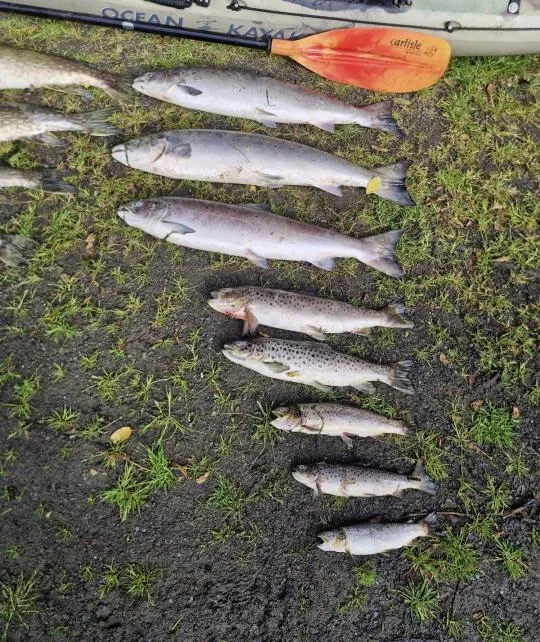
credit: Inland Fisheries Ireland (IFI) 5 Dead Brown Trout 3 Dead Salmon – June 2026
Inland Fisheries Ireland (IFI) is continuing to investigate a serious fish kill on the River Glyde in Co Louth.
IFI estimates that more than 20,000 fish have died in the incident over an approximate 25km stretch of the river.
The impacted area spans from Aclint Bridge, Co Monaghan to Lynns Weir, Castlebellingham, Co Louth.
IFI officers have been conducting sampling and clean-up operations on the river, and deploying kayak, drone and foot patrols to assess the affected area.
Fish mortalities include Atlantic salmon, eel, brown trout, pike, minnow, and coarse fish species.
The source of the pollution has been identified as an agricultural discharge, and has been stopped.
Water samples taken at the river have been sent for laboratory analysis.
A file is now being prepared for potential prosecution.
Inland Fisheries Ireland continues to urge the public to report instances of fisheries concern to its confidential 24/7 number, 0818 34 74 24.
–
A Judge at Ballinsaloe District, Co. Galway, has refused jurisdiction in an alleged animal cruelty case.
Judge James Faughnan was dealing with a case being taken on behalf of the Minister for Agriculture against Eugene Costello of Cloonfree, Taughmaconnell, Co Roscommon.
The case relates to an incident of poor animal husbandry and animal overstocking on Mr Costello’s property.
Judge Faughan in response to being show photographs of the animals involved in the case refused to accept jurisdiction and referred the case to Central Criminal Court once the book of evidence had been prepared.
The case will be mentioned at the 23rd July sitting of Ballinasloe Court, Co. Galway in order to confirm that Judge Faughan’s order has been compiled with.
–
A Dublin horse carriage owner has been fined for animal cruelty at Dublin District Court.
Jake Martin (25) O’Hogan Road, Ballyfermot, Co. Dublin was fined €1,000 for animal cruelty.
The case before Judge John Hughes involved Mr Martin’s horse being seized by the Gardaí on the October 11, 2024. A Garda observed the animal in poor and malnourished condition. The animal was being used to in the tourist horse carriage trade in Dublin city.
A veterinary examination of the horse found that it was too old to be involved in carriage hauling due to its age and body condition.
Mr Martin pleaded not guilty to the charges and told the court that he cared for the horse and it was being cared for.
Judge Hughes ordered the forfeiture of the horse to the State.
–
Galway SPCA have highlighted a recent incident of a kindle of kittens been abandoned in a shopping trolley. Thankfully, a passer-by known as John, found the kittens and informed the organisation who took the animals into shelter and care.
The Galway SPCA Facebook post reads:
Yesterday was another reminder of just how challenging kitten season can be…..
These little ones were found abandoned in a shopping basket beside a very busy road and brought to our attention by John, who thankfully stopped what he was doing and went to their aid when he heard their desperate cries…
We are grateful that they were found before something far worse happened…. At this time of year, rescues are contacted daily about cats and kittens needing help….
We do everything we can to support as many animals as possible, but the reality is that rescue capacity is not unlimited Space, Funding, and Resources are stretched, and sometimes we simply cannot take in every animal immediately… When animals are abandoned, it doesn’t solve the problem… It simply transfers the responsibility and risk to someone else.
More importantly, it places vulnerable animals in danger. The most effective way to prevent situations like this is through early neutering and responsible pet ownership… Rescue should be the safety net, not the plan!
This little family is now safe and receiving the care they need, We’ll share updates on their progress over the coming weeks…
*Please note*
They are Not available for adoption and we will not be taking names or expressions of interest at this time
When kittens become available for adoption, homes are matched based on suitability and personality of the animals and the adopters.
Thank you to John for finding them and making sure they got the help they needed! end
Animal welfare organisations continue to appeal to companion animal guardians or potential guardians to get their animal/s neutered. Doing so avoids unwanted animal litters that end up being dumped by those who refuse to engage with animal welfare organisations.
Visit/Donate: Galway SPCA
https://www.facebook.com/GalwaySPCA
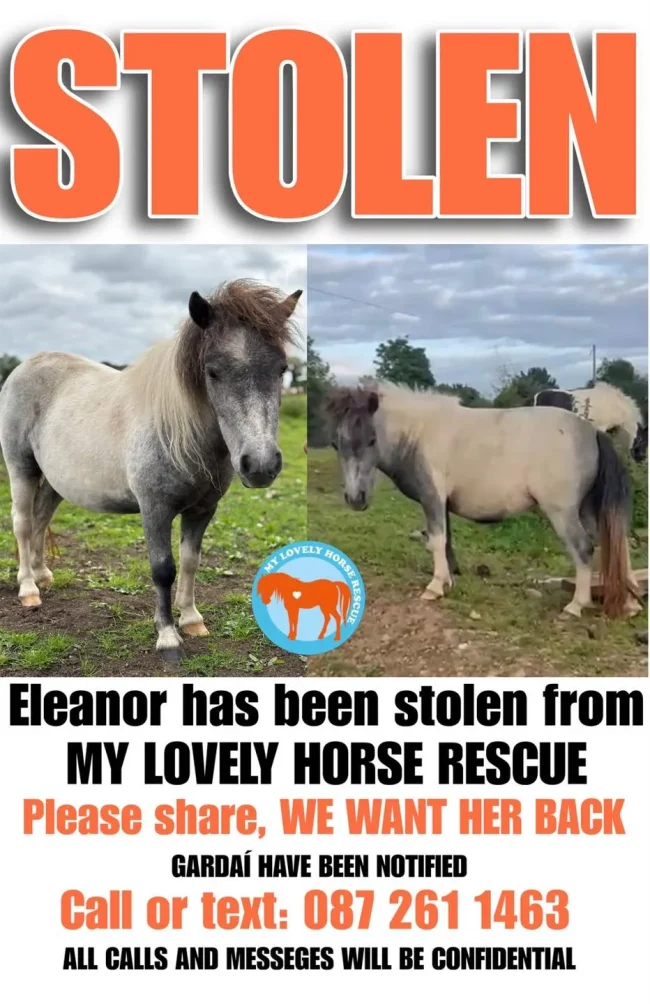 Credit: FB My Lovely Horse Rescue
My Lovely Horse Rescue has offered a €1,000 reward for the return of a stolen pony.
The organisation has reported that Eleanor, a pony that was rescued two years ago, has been taken from their sanctuary in Co. Kildare.
Members of the public are being asked to report any sightings of Eleanor, a falabella pony with grey and white markings, while an appeal has been made to the person/s responsible for this theft to return the animal. Gardaí have been informed of the missing pony and investigating the theft which it believed took place over the Bank Holiday weekend.
My Lovely Horse Rescue can be contacted on 087 2611463. Any contact with information about Elanor’s current location will be treated in the strictest confidence.
Visit/Donate:
https://www.mylovelyhorserescue.com/
–
As of the 17th May 2026, 202,916 cattle (including calves) have been exported from Ireland this year.
86% (or over 175,500 animals) were exported to EU countries, while the exporting figure of number of animals exported is down 15% on the same time period/2024 when 239,102 cattle had been exported.
Up to 17th May 2026:
Cattle Exports including Calves:
Netherlands/72,476
Spain/63,533
Italy/24.695
Northern Ireland/20,017
Croatia/8,122
Israel/3,531
Algeria/3,299
Hungary/3,232
Portugal/1,819
Greece/743
Poland/571
Tunisia/538
Slovenia/136
Slovakia/130
Romania/58
Great Britain/13
Other/3
Total: 202,916
Source: Department of Agriculture, Food and the Marine, DAFM
Up to the 17th May 2025, 161,190 calves were exported from Ireland to various EU countries. The Netherlands, Spain and Italy are the main destinations for Irish calves with an increase in calf exports to Croatia on this time last year. Due to bluetongue restrictions in Poland, the number of calf imports from Ireland into this country has declined on previous figures.
Up to the 17th May 2025:
Calves Exports:
Netherlands/72,058
Spain/54,415
Italy/16,953
Croatia/7,521
Northern Ireland/5,656
Hungary/3,168
Portugal/989
Poland/429
Other/1
Total: 161,190
(Up to 17th May 2025)
Calves classified as all bovine animals under three months of age.
Source: Department of Agriculture, Food and the Marine, DAFM
–
A Ministerial appointee to the board of Horse Sport Ireland, the national governing body for equestrian sport, featured in a 2021 constructive dismissal case brought by a Northern Ireland vet.
Robert Huey, Northern Ireland chief veterinary officer, was heavily criticised in a 2021 ruling in a constructive dismissal case won by Tamara Bronckaers, a Department of Agriculture, Environment and Rural Affairs vet. Ms Bronckaers has raised animal welfare concerns in a protected disclosure.
The tribunal found Huey’s actions were “detrimental” to Ms Bronchaers.
She received a £1.25 million (€1.44 million) settlement from the Department of Agriculture, Environment and Rural Affairs (DAERA).
The Department of Agriculture, Food, and the Marine (DAFM) did not respond to media enquiries regarding the appointment of Mr Huey in light of his role in the events which saw Ms Bronchaers taking her unfair dismissal action.
–
–
-end
Thank you for reading our animal news articles.
Bookmark: www.animalnewsireland.com
Don’t forget to tell your tribe about our website, animalnewsireland.com, Ireland’s source for animal-related news.
The Irish Council Against Bloodsports (ICABS) have highlighted the issue of horses on public roads. It is asking the public that if you see horses/ponies including horses being used in sulky racing, on a motorway, you should contact the Gardaí immediately. Road traffic legislation prohibits the presence of horses and horse-drawn vehicles on motorways.
Insert into your Contacts:
Garda National Roads Policing Bureau
T: 01 666 1792
T: 01 666 1954
In each Garda division, there are dedicated Roads Policing Units which are responsible for enforcing road traffic legislation.
Garda Confidential Line
T: 1800 666 111
The Garda Confidential line allows the public to call with confidential information relating to matters of crime or other activities.
–
A German television station, WDR, recently broadcasted a programme about the work of My Lovely Horse Animal Rescue. The hard-hitting documentary highlighted the work of this organisation as it deals with horse welfare issues in Ireland.
Footage of horse cruelty on Irish public roads including horses been hit, ridden at speed, and sulky running was shown.
The documentary will be used as part of the campaigning efforts by animal welfare organisations to strengthen animal welfare legislation at EU level.
WDR TV – German only
https://www1.wdr.de/index.html
View a Documentary Extract:
https://www.facebook.com/reel/2198442044227034
–
Attempts to refloat a fully grown male dolphin found stranded on Sandymount Strand in south Dublin have failed. Despite the efforts of a number of organisations to guide the animal, about 100kg and 2.3 metres long, out to sea, it stranded itself against some rocks and died.
The animal was removed from the area and taken to University College of Dublin (UCD) for a post-mortem examination. It is hoped the findings will provide an explanation as to why the animal stranded itself, and its cause of death.
A post-mortem on the dolphin looks for:
Signs of illness or infection — such as parasites, viruses, or bacterial disease that could weaken the animal.
Physical trauma — injuries from boats, nets, predators, or rocks during stranding.
Nutritional condition — whether the dolphin was underweight, dehydrated, or starving.
Organ health — especially the lungs, liver, kidneys, and heart, which can reveal long‑term health problems.
Evidence of stress or shock — common in stranded marine mammals.
The findings will contribute to our understanding of dolphin strandings and enable researchers to investigate these occurrences further.
Visit/Support: Irish Whale and Dolphin Group
https://iwdg.ie/
–
At Sinn Féin’s Ard Fheis, held at the Waterfront Conference Centre, Belfast, 24th/25th April, delegates debated and voted on two foxhunting motions. Motion 28 which supported the continuation of regulation fox hunting was rejected, while Motion 29 which calls for the party to support a ban on the practice of fox hunting with dogs for the sole purpose of leisure, and mandates the party to engage with rural communities to ensure that such a ban is introduced in a way that does not unduly impact rural life, was passed after a heated debate.
Motion 29:
That this Ard Fheis Recognises;
Sinn Féin’s unwavering support for rural culture and traditions, the right of farmers to defend their livestock from predators such as foxes and dogs, and the need to protect hunting and fishing activities for the purpose of obtaining food or managing species populations;
The economic social and cultural importance of sports involving animals to the Irish nation as a whole, and that regulation can and does ensure the welfare of the animals in the vast majority of these sports;
Accepts;
That the hunting of foxes using dogs for the sole purpose of leisure is unavoidably cruel and by necessity inflicts terror, exhaustion, irrevocable injury, and death on the foxes involved;
That fox hunting is a legacy of British colonial rule and causes damage to crops and livestock of farmers whose land faces are trespassed by large numbers of horses and dogs;
The consistent evidence that fox hunting is rejected by the vast majority of people living in rural Ireland, with 74% of rural dwellers opposing fox hunting in a 2019 poll by Red C, and similar support for a ban across the Connacht-Ulster region of the 26 Counties (73%), Leinster (71%) and Munster (69%) in a 2025 survey by Ireland Thinks;
Commits; To support a ban on the practice of fox hunting with dogs for the sole purpose of leisure, and mandates the party to engage with rural communities to ensure that such a ban is introduced in a way that does not unduly impact rural life.
Animal campaigners have welcomed this historic decision and called on Fianna Fáil and Fine Gael to reflect the views of the vast majority and support a ban this barbaric, colonial bloodsport.
–
A livestock ship journey from Waterford to Algeria in January of this year resulted in twenty-four animals being injured or developing an illness which resulted in seven of the animals dying. It is not clear how many of the seven animals died naturally or had to be euthanised.
The Department of Agriculture, Food and the Marine (DAFM) have said that the mortality rate is higher than usual as in most instances the mortality rate of cattle exported from Ireland while in transit is low The DAFM approved livestock ship, which was not named, had a department vet on board whose role was to monitor animal welfare standards during the voyage.
In response to the veterinary report, the DAFM has said it reviews its processes and procedures around the transport of animals by dedicated vessel aligned to relevant EU and National Regulations on an ongoing basis.
Animals can only be transported on a dedicated livestock vessel which has been approved by DAFM in accordance with the provisions of S.I. No. 356/2016 – Carriage of Livestock by Sea Regulations 2016.
The distance between Ireland and Algeria is approximately 2,298 nautical miles (about 4,255 km), specifically measuring from Dublin Port to the port of Algiers. A livestock ship usually takes five to seven days to reach its destination port in Algeria.
–
A rescheduled date has been announced for a Walk in Solidarity for Animal Welfare & Road Safety. The event will be held on Saturday, 9th May at 3pm, following its postponement in April, due to the fuel protests.
Participants are asked to assemble at Irishtown Car Park, Clonmel, Co. Tipperary . The walk will head to Clonmel town to raise awareness about animal welfare, road safety, and community inclusion.
The event is being organised by Cllr Michael “Chicken” Brennan and Cllr Liam Browne, both members of Tipperary County Council, in partnership with My Lovely Horse Rescue.
The event aims to draw attention to the increasing dangers associated with sulky running on public roads. The organisers emphasise that the practice poses significant risks both to those involved in the activity and to other road users, while also raising serious concerns regarding animal welfare.
The Roads Act 1993, Section 74 provides a legal framework to permit, prohibit, or impose conditions on races such as Sulky Racing/Road Racing. Organisers of road races involving animals must meet strict organising criteria before permission is granted by the local authority and Gardaí. Unlicensed, unnotified races on public roads are illegal, and organisers can be prosecuted.
The councillors stress that this protest is intended to serve as a national demonstration, not merely a local event, and is designed to begin a comprehensive debate on the need for robust national legislation regulating all aspects of sulky use in Ireland.
–
It has been reported that a Dutch truck that was transporting more than 300 calves from Ireland to the Netherlands has overturned on a highway in northern France, killing over 100 animals.
The accident happened on the A29 motorway near Framerville-Rainecourt, in the Somme region. It is understood the vehicle, which had two levels and an attached trailer, fell into a ditch.
Firefighters assisted by veterinarians, attended the crash site. Reports has said that there were 306 calves on board, and it is believed that 107 calves were killed in the crash. Emergency services had to cut open the vehicle to rescue the surviving calves.
This incident is yet another example of the risks linked to long-distance transport of live animals across Europe.
The Department of Agriculture, Food, and Marine(DAFM) has reported that in the first 15 weeks of 2026, 95,504 calves have been exported from Ireland. Calf export figures to date this year are down 17% on 2025. The countries are importing Irish calves are: Netherlands/43,326; Spain/30,803; Italy/11,632; Croatia/4,187; Hungary/1,745; Portugal/550; and Northern Ireland/3,260.
The market for Irish calves in Poland has collapsed due to protocols put in place for trading Irish calves to customers in this country, which Irish calf exporters have described as unworkable.
–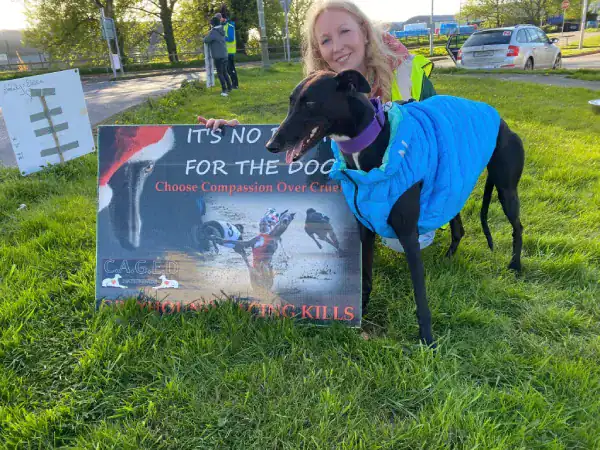 credit: DSR Limerick FB – Anti-Greyhound Protest – Greyhound says No to Death Racing
Deel Sighthound Rescue, based in Newcastle West, Co. Limerick held an anti-greyhound racing demonstration last Saturday night at the Greenpark Roundabout, Dock road, Limerick.
The large attendance of local Limerick people were joined by animal welfare supporters who travelled from Dublin, Cork, Tipperary, and other locations around Ireland. There was also a canine turnout who wanted to show their opposition to an activity that causes so much suffering and death to fellow dogs.
A Deel Sighthound Rescue (DSR) spokesperson said that people are tired of seeing their taxpayers’ money ring-fenced in every budget and handed over without question to the greyhound racing industry. If the industry is as successful as it claims to be, then why does it continue to depend so heavily on public funding?
According to DSR, since the shocking revelations in the RTÉ Prime Time: Greyhounds Running for Their Lives documentary (aired-June2019), the public was promised reform and improved welfare. Yet years later, the reality for greyhounds has not improved, in fact it’s far worse.
The organisation highlighted that:
More Greyhounds than ever are dying and being injured on tracks;
Greyhounds are still being killed for not making the grade;
An industry that continues to operate behind a wall of public funding and self-regulation;
A system that treats gentle dogs as disposable commodities.
Deel Sighthound Rescue (DSR) says it is time for this dog-killing, money-wasting, scandal-ridden machine to be decommissioned. Greyhounds are sensitive, affectionate dogs who deserve safety, respect and loving homes — not to be part of a system where their lives are measured only by how fast they can run.
With fellow animal campaigners, Deel Sighthound Rescue’s campaign to ban greyhound racing will continue until greyhounds are no longer exploited for gambling in Ireland.
Visit/Donate: Deel Sighthound Rescue
https://www.facebook.com/DeelSighthoundRescue/
–
The Department of Agriculture, Food and the Marine (DAFM) have reported that up to April 12, just over 126,000 cattle in the first 15 weeks of 2026 have been exported from Ireland.
This figure represents a 21% decrease compared with the same period in 2025, when more than 160,000 cattle had been exported. However, when compared with 2024, exports are only 1% lower — 127,658 cattle were exported during the same period that year.
Breakdown of the animals exported: up to April 12, 2026
Calves/95,504
Weanlings/11,391
Stores/7,706
Adult cattle/12,073
Total: 126,044
In relation to calf exports, an increase has been reported in shipments to Croatia. In the first 15 weeks of 2026, 4,187 calves were sent there, compared with 1,136 Irish calves in 2025.
–
At Dublin Circuit Criminal Court, an 81‑year‑old licensed hunter, Maurice Mahon, Strand Road, Bray, Co Wicklow, has been convicted of reckless discharge of a firearm at Kilmashogue Lane in Rathfarnham, Dublin on August 28th, 2022, and assault causing harm after shooting Innokenti Belaga in the leg while Mr Belaga was meditating in his back garden of his rented house in Rathfarnham, Co. Dublin.
Mr Mahon had been hired to cull deer on adjacent land and claimed he fired at what he believed was a fox or a dog near sheep. The shot instead struck Mr Belaga, shattering his femur. Mr Mahon assisted the injured man and called emergency services.
Mr Belaga suffered life‑altering injuries, spending a month in hospital and extended time in rehabilitation. Formerly a highly active athlete, he now relies on walking sticks, experiences frequent falls, and cannot return to his previous physical lifestyle.
He also lost his home due to the level of care he required and is currently homeless. In a victim impact statement, he described profound emotional and physical consequences, particularly the impact on his young daughter, from whose life he says he “disappeared overnight.”
Mr Mahon, who has no previous convictions and decades of experience in wildlife management, initially told Gardaí he had fired a shot at what he thought was a fox in the vicinity of sheep but later said he thought it was a dog worrying sheep.
Judge Elma Sheahan ordered a Probation Service assessment of the defendant and sentencing is scheduled for July 27th. Mr Mahon remains on continuing bail.
–
The Irish Whale and Dolphin Group (IWDG) are reporting that on the 11th of April there was a rare shark landing in Co. Sligo. credit: IWDG FB – The Greenland Shark – Co. Sligo
The IWDG Live Stranding hotline received a report of a 2-metre dead basking shark. Photographs confirmed however that this was not a basking shark, but a very rare and interesting stranding.
The Greenland Shark is the longest living vertebrate in the world with a life span of several centuries; the oldest recorded specimen was over half a millennium in age. A large species, they typically reach lengths of 4 to 6 metres.
Little is known about the elusive Greenland Shark in Ireland, native to deep and remote waters of the Arctic and North Atlantic, however they are known to reach sexual maturity around 150 years of age and give birth their pups live after a gestation period of 8 to 18 years.
At 2.87 metres, this male individual in Sligo had very developed claspers, perhaps on the brink of maturity.
The Natural History Museum (National Museum of Ireland) have recovered the animal for dissection and collaboration with interested researchers.
A Museum spokesperson said the remains of the rare 3-metre-long Greenland shark (Somniosus microcephalus) has been successfully recovered from the shoreline in County Sligo, marking the first recorded stranding of this species on the Irish coast.
The shark is now undergoing detailed scientific post-mortem examination, contributing valuable data to the understanding of this elusive deep-water species. Tissue samples and selected anatomical components are being preserved as part of the National Museum’s scientific collections, ensuring a permanent record of this exceptional specimen.
The Greenland shark, known for its extreme longevity and deep-sea habits, is exceptionally rare in Irish waters, and this stranding represents a significant opportunity for research into its biology, health, and ecology.
Subject to the condition of the skin and its suitability for preservation, the National Museum hopes to display the specimen in the future, which would allow visitors to learn more about one of the world’s most mysterious shark species and the scientific work undertaken to study it.
View: Irish Whale & Dolphin Group https://www.facebook.com/IrishWhaleandDolphinGroup
View: The National Museum of Ireland
https://www.museum.ie/en-IE/News/Rare-Greenland-Shark-Recovered
–
A walk to highlight the dangers associated with sulky running on public roads has fallen victim to the ongoing fuel protests in Ireland.
The event, due to be held in in Clonmel, Co. Tipperary on the 11th April, has been postponed to a later date.
Organisers, Cllr Michael Brennan Cllr Liam Browne, along with My Lovely Horse Rescue, have said they will continue to raise this animal welfare issue and thank their supporters for their continuing support, understanding and messages of encouragement. A new date for the peaceful walk will be announced soon and will be notified to public, social media, and media outlets.
The Roads Act 1993, Section 74 provides a legal framework to permit, prohibit, or impose conditions on races such as Sulky Racing/Road Racing. Organisers of road races involving animals must meet strict organising criteria before permission is granted by the local authority and Gardaí. Unlicensed, unnotified races on public roads are illegal, and organisers can be prosecuted.
–
On the 1st April last, the MV Alondra livestock ship sailed out of Foynes Port, Co. Limerick bound for Algeria. It was carrying a consignment of 1,665 continental bulls assembled by Maxwell Livestock.
This Roscommon based livestock trading company has been supplying the Irish live animal export trade for years. This shipment was the first time the company chartered its own vessel to export cattle.
A company spokesperson said the cattle arrived at their destination in good health, and that their customers were happy with the animals. It is expected that further cattle shipments to Algeria will take place this year.
In 2017, the MV Alondra was converted from a bulk carrier to a livestock carrier in Denmark, where it was then certified under Australian specifications. The ship can carry thousands of animals including calves, cows, pigs, sheep, donkeys, horses, and camels.
The distance between Ireland and Algeria is approximately 2,298 nautical miles (about 4,255 km) by sea, specifically measuring from Dublin Port to the port of Algiers. A livestock ship usually takes five to seven days to reach its destination port in Algeria. The Algerian port the MV Alondra sailed to has not been disclosed.
–
In a second multi-agency operation in a week targeting cock fighting in Co. Tipperary, a suspected venue has been raided in Tipperary town.
Community gardaí, a Department of Agriculture, Food and the Marine vet and officials from the National Parks and Wildlife Service (NPWS) and the National Society from the Prevention of Cruelty to Animals (NSPCA) searched a premise in Tipperary town. They found a number of fighting roosters in appalling condition and they were taken into veterinary care.
During the course of the raid, one man was arrested for alleged offences contrary to the Animals Welfare and Health 2013. He was brought to Tipperary Garda Station for questioning and to be charged with a number of offences including animal cruelty.
Investigation into cock fighting in Tipperary are ongoing. Gardaí have renewed their appeal for information on cock fighting activity as part of the effort in stamp out this illegal activity.
–
A shooting incident a Red Kite ((Milvus milvus) is currently being investigated by the National Parks and Wildlife Service (NPWS). Last February, the body of a bird was found on a farmland in the Baltrana area of North West Co. Meath. An x-ray of the bird revealed shotgun pellets in its body.
Under Irish Wildlife legislation, the Red Kite is protected. Persecution of the bird is illegal and convictions under legislation can carry a fine of up to €5,000 and 12 months imprisonment. A maximum fine of €500,000 and three years on conviction is possible under indictment.
By the early 19th century, the Red Kite was extinct from Ireland (Golden Eagle Trust Ireland, 2021). In 2007, a programme saw the reintroduction of the Red Kite to County Wicklow. This was followed up with another release programme in Fingal, Co. Dublin.
The NPWS is appealing for anyone that may have any information regarding this incident or any suspected bird of prey persecution to contact them.
National Parks and Wildlife Service
T: 01 888 2000
E: WildlifeEnforcement@npws.gov.ie
–
-end
Thank you for reading our animal news articles.
Bookmark: www.animalnewsireland.com
Don’t forget to tell your tribe about our website, animalnewsireland.com, Ireland’s source for animal-related news.
Contact Our Newsdesk
Support Animal Journalism
Read: Animal News Digest 2025
 credit:. Waterford Animal Welfare FB page – Horse Cruelty Case
A multi-agency operation, involving various authorities, has uncovered a suspected cock fighting venue in Co. Tipperary.
Officials from Tipperary County Council, the National Society for the Protection of Cruelty to Animals, the National Parks and Wildlife Service and the Department of Agriculture conducted a search of a property in Tipperary town and seized various items linked to the illegal activity of cock fighting. No arrests were made.
During the raid, officials seized items including bird cages, medication, steroids, antibiotics and imported illegal substances. No animals were present at the premises.
Cock fighting blades known as gaffs were also found at the premises. A gaff is a type of blade that is attached to a rooster’s leg before a cock fight.
All seized items will be subject to further forensic and technical analysis.
Gardaí are investigating the matter and have appealed for information on cock fighting activity in Co. Tipperary in effort in stamp out this illegal activity.
–
A sheep welfare case heard at Gorey District Court was described by Judge John Cheatle as the worst animal welfare breach he had seen in his lifetime.
Tom Eilis (55) of Ballyvellis, Gorey, Co. Wexford, faced a number of animal welfare charges in relation to animal carcasses found on his farm in Gorey.
Gardaí attended the farm in response to calls about animal carcases and discovered around 250 dead animals, mostly sheep, in various stages of decomposition on his land. They also found sheep that were malnourished and suffering from sheep scab, a painful and highly contagious skin condition.
Mr Ellis admitted responsibility, explaining to the court that a recent road accident left him with reduced mobility and financial hardship. He said he couldn’t afford the €150-per-animal cost to remove the carcasses. His legal counsel told the court that Ellis deeply regretted the situation and had been overwhelmed at the time.
Since the incident, Mr Ellis has engaged with mental health services, completed animal welfare courses, and set aside €2,000 to donate to an animal welfare charity.
Judge John Cheatle decided the matter could not yet be finalised and ordered a veterinary inspection of the farm before determining sentencing. The case was adjourned to the next sitting of the court on April 4.
–
A violent inter-family dispute in West Waterford escalated dramatically last August when a man allegedly broke into a home and stabbed a dog with a pitchfork.
Waterford Circuit Court heard the incident unfolded on the evening of 12 August 2024, when Peter Allen (31) and his mother, Marie Power (47), flagged down Gardaí in Lismore to report the break‑in.
They alleged that James Whelan (29), from Stradbally, Co. Waterford forced his way into the Cappoquin home of Peter Allen and deliberately attacked Allen’s Staffordshire dog with a pitchfork. The dog survived its injuries.
Despite Garda, instructions to stay back, the pair went to confront Mr Whelan and his partner, Shannon Power.
This resulted in a chaotic street altercation that was captured on CCTV. Footage showed Marie Power and Shannon Power squaring up to each other, while Allen’s aunt, Patricia Allen (53), was seen punching James Whelan. Gardaí had to use pepper spray to break up the fight. A red garden shears were recovered at the scene.
All four individuals were charged with violent disorder. The court also heard that each had a significant history of previous convictions.
Marie Power, Peter Allen, and Patricia Allen received suspended sentences and were ordered to keep the peace. Whelan’s case was adjourned until April 2027 while he undergoes an intensive rehabilitation programme.
–
The Director of Public Prosecutions (DPP) is seeking to revoke the bail of Mayo farmer Seán Coughlan, Cum, Lahardane, Ballina, Co. Mayo who faces thirty-eight charges of animal cruelty connected to a dairy farm in Laragan, Elphin, Co. Roscommon. Thirty-five of the charges are against his company, Coughlan Farming Limited.
The case arose from allegations related to the deaths of up to 500 calves on the between 2023 and 2025. At a previous court appearance, a Department of Agriculture (DAFM) inspector outlined that the male-to-female calf death ratio at the farm was roughly 50:50.
The DPP argues that Coughlan breached his bail by failing to respond to correspondence sent in January 2026. Mr Coughlan, representing himself, denied any breach of bail conditions and told the court that his legal team withdrew unexpectedly from the case ten days earlier. The court heard that Coughlan lost legal representation because he didn’t properly respond to a Section 150 notice about legal costs. He claimed he only recently received the relevant documents and blamed Eircode issues for misdirected post.
Judge Kenneth Connolly described the situation as “very serious” and said he would be inclined to revoke Mr Coughlan’s bail if a breach was proven. Judge Connolly adjourned the DPP’s application to a March 24 court sitting on the condition that Coughlan address issues related to the operation of his farm.
Update: 24th March – At Roscommon Circuit Court, Séan Coughlan, had his bail revoked and was remanded in custody after refusing to comply with new bail conditions. Mr Coughlan will remain in custody ahead of his trial, which is due to commence before Roscommon Circuit Court on June 3, 2026.
–
Pat Fouhy,(78), Ballydawshe Stud, Ballynella, Co. Cork received a lifetime ban of dog ownership following the hearing of his appeal against the severity of a €1,500 fine for causing unnecessary suffering to a dog, contrary to the Animal Health and Welfare Act 2013, by failing to bring the dog to the vet. A five-year ban on dog ownership on Mr. Fouhy was also imposed at the time of the court case.
The initial court case arose when ISPCA Inspector Caroline Faherty was visiting Mr Fouhy property on an unrelated issue on the 13th April 2023 when she observed a dog in distress and limping with a swollen leg. The animal was removed to receive veterinary treatment. A vet who attended the animal estimated that a fracture of the leg has taken place a few days ago. Following veterinary advice, the dog’s leg was amputated and the animal has made a full recovery.
Mr Fouhy legal representative, Mahon Corkery, informed the court there was no suggestion that his client had anything to do with the injury to the dog and the case was based on failure to report the injury to a vet for treatment.
Judge Sinéad Behan increased the ban on dog ownership from five years to a lifetime ban saying that the dog was in pain for a sometime and that had to be acknowledged by the court. An earlier fine of 1,500 was reduced to €350 on account Mr Fouhy poor health and circumstances.
–
A 2024 suspected cock fighting event has resulted in the arrest and charge of a man for involvement in suspect illegal activity. Monaghan Gardaí arrested the suspect as part of their investigation of an incident where gardaí received a report on the July 27, 2024, of a suspected illegal “cock fighting” event allegedly taking place at a private residence in Emyvale, Co. Monaghan.
The Department of Agriculture, Food and the Marine (DAFM) provided assistance as Gardaí served a warrant to search the residence under Section 45 of Animal Health and Welfare Act 2013.
It is understood a number of individuals ran from the property as the authorities arrived. A Garda search resulted in 15 dead roosters been discovered, while a further 70 roosters were taken into the care of DAFM staff. Gardaí also seized evidential material of suspected “cock fighting”.
Monaghan Gardaí are continuing to investigate this incident as an animal welfare issue.
According to the Animal Law Ireland website with reference to Organised Animal Fighting and Baiting
Section 15 of the Animal Health and Welfare Act 2013 prohibits animal fighting, baiting, or any other performance that involves animals. It is illegal to publicise or promote such events, provide information about them, or receive money for admission to them. The Act also prohibits the use of animals for fighting, training, or baiting purposes. Violation of this section can result in a fine or imprisonment.
Dog-fighting,
Cock-fighting
Animal-baiting e.g. “Badger baiting”
“Blooding” of dogs/greyhounds with live animals
throwing or casting with ropes or other appliances any unbroken horse or untrained bovine,
riding or attempting to ride an animal which, by the use of any appliance or treatment, is or has been stimulated with the intention of making it buck, or any other activity that may cause unnecessary suffering to an animal and is prohibited by animal health and welfare regulations.
Ref: Animal Law Ireland. (2023). Organised Animal Cruelty. [online] Available at: https://animallaw.ie/types-of-crime/organised-animal-cruelty/.
–
Waterford Animal Welfare (WAW) reports that on the 19th March last, they were involved in a rescue call involving a deer caught in netting in Knocklofty, Co. Tipperary. When WAW volunteers attended the scene it was clear that the deer was very distressed and would need to be sedated for our own safety before a rescue attempt could be made. Veterinary assistance, by way of sedating the animal, was provided by Suirside Veterinary Clinic, Carrick-on-Suir.
It took over thirty minutes to fully remove the netting for the deer’s antlers. The animals was monitored until the sedation wore off , and then the deer was released into the wild. credit: Waterford Animal Welfare FB – Deer Trapped in Netting – Knocklofty, Co. Tipperary
–
A deer killing programme has started in the Achill area of Co. Mayo in response to a sharp rise in deer‑related road accidents in recent years. Local residents have reported numerous collisions and near misses on roads across Achill, Currane, and on the Achill–Mulranny route. These incidents have caused significant vehicle damage, hospitalisations, emotional trauma, and financial costs.
FRS Co‑Op Deer Management Programme in collaboration with local licensed gun club members are implementing lethal deer control on deer in the areas.
The shooting is being carried out licensed and insured hunters, operating under the Wildlife Acts and with the appropriate permissions.
By killing the deer, it is hoped the deer numbers will decrease, road accidents involving deer will reduce and the deer herd will return to upland areas and away from the rural road network.
Local landowners and residents have been supportive of the deer control efforts. Despite early signs of a reduction in traffic/deer incidents in some areas, the deer shooting and killing will continue for the coming months.
In 2023, 15 Deer Management Units (DMUs) were established across Ireland following recommendations from the Deer Management Strategy Group. This was part of the Government’s response to calls by pro-deer killing organisations and landowners for a national deer cull.
–
A dog attack on sheep has been reported from Co. Longford. Over two days, thirty sheep, nine lambs and 21 ewes, were attacked and killed on farm outside of Longford town. A number of other sheep were injured and are receiving veterinary treatment. Gardaí are investigating the incident, and have appealed to dog owners to ensure that their animals are kept under control near farmland.
The Local Authority Control of Dogs Statistics Report (2024) recorded 287 incidents of dog attacks on animals involving 2,077 animals.
–
Waterford Animal Welfare (WAW) have reported an incident of horse abuse and death in Co. Waterford. Responding to a call concerning horse welfare, they came across a horse in a distressed state. The animal was loaded into a horsebox so that it could be taken for veterinary treatment. However, the animal was declining during the journey to Suirside Veterinary Clinic.
A large animal vet observed that mare was malnourished, dehydrated, had a severe respiratory infection and was in heart failure. Based on this information, the humane thing to do was to put the animal to sleep.
WAW highlighted that the horse had no owner and was not microchipped as legally required. They believe that there will be no accountability for the treatment of this animal and that no court case for an animal cruelty offence will follow.
Waterford Animal Welfare is a non-profit organisation based in Waterford. It provides a voluntary animal rescue including 24/7 emergency rescue, rehabilitation and re-releasing, public advice and adoption.
Visit/Support: Waterford Animal Welfare
https://www.waterfordanimalwelfare.com/
https://www.facebook.com/waterfordanimalwelfare
–
Gardaí in Clare are investigating an illegal hunting incident. It was reported that on the 1st March, a number of men with dogs entered land at Loughrask, near the village of Ballyvaughan, Co. Clare, for the purpose of hunting.
Gardaí are appealing to anyone who may have witnessed the incident to contact Ballyvaughan Garda Station-065-7077002. To report any illegal hunting incidents,contact the Garda Confidential Line on 1800 666 111, or any Garda station.
–
Stand with Badgers are highlighting that March 1st saw the closure of the Hedge Cutting season in Ireland. From this date, it is illegal to cut, grub, burn or otherwise destroy vegetation growing in hedges or ditches in Ireland under the Wildlife Acts.
The hedge cutting closed season is to protect nesting birds and wildlife during their breeding season. The organisation are asking members of the public to report any hedge cutting incidents to the relevant authorities. The advice is to take video/photographs of the activity and to pass this visual evidence plus the location where the hedge cutting took place to the National Parks and Wildlife Service.
The National Parks and Wildlife Service website outlines the following information:
Restrictions on Cutting Hedgerows and Burning
Section 40 of the Wildlife Act 1976 prohibits the cutting, grubbing, burning or other destruction of vegetation growing on “any land not then cultivated” between 1st March and 31st August annually.
This is to protect bird life during the nesting season, to help prevent forest fires, and to protect vegetation and wildlife habitats during the months of growth and reproduction.
The legislation allows for some limited exemptions.
For business, landowners and the general public the most notable of these exemptions are:
The destruction, in the ordinary course of agriculture or forestry, of any vegetation growing on or in any hedge or ditch.
The clearance of vegetation in the course of road or other construction works or in the development or preparation of sites on which any building or other structure is intended to be provided;
The felling, cutting, lopping, trimming or removal of a tree, shrub, hedge or other vegetation pursuant to section 70 of the Roads Act 1993.
Section 40 breaches can be reported to: NWPS Office 01 888 2000
Support: Stand with Badgers https://www.facebook.com/p/Stand-with-Badgers
–
-end
Thank you for reading our animal news articles.
Bookmark: www.animalnewsireland.com
Don’t forget to tell your tribe about our website, animalnewsireland.com, Ireland’s source for animal-related news.
Contact Our Newsdesk
Support Animal Journalism
Read: Animal News Digest 2025
 Credit: FB My LHAR – Anne – Victim of Urban Horse Abuse
Ms Caroline Geraghty with an address of Apartment 36, Harbour Point in Longford recently appeared at Longford District Court to face a charge of animal neglect under the Animal Health and Welfare Act.
It is alleged that on January 15, 2025, at Apartment 36, Ms Geraghty was “neglectful or reckless regarding the health or welfare of an animal, namely a grey rabbit (thumper) by failing to provide the rabbit with basic veterinary care.”
Ms Geraghty’s solicitor, Diarmuid Quinn, made an application to Judge Bernadette Owens, for legal aid on behalf of his client, as she was not in employment. Legal aid was granted, and Ms Geraghty’s will appear before Longford District Court on March 24, which it is expected that the case will be heard and finalised.
–
A Limerick judge has commended the bravery of a local man who intervened during a violent dog attack that left a puppy fatally injured in Castletroy, Co. Limerick nearly two years ago.
At Limerick District Court, Claudia Farrell, Castlebrook Green, Castlebrook Manor, Castletroy, Co. Limerick faced a number of charges arising from an incident on the 25th June, 2024.
A woman walking her young son and pet puppy along the Greenway at Willowfield Green encountered two unleashed dogs. One of them — a large Staffordshire Bull Terrier — suddenly lunged and seized her puppy in its jaws.
Hearing screams, local resident Luis Eduardo rushed from his home, fearing for the safety of nearby children. Unable to free the puppy from the dog’s grip, he placed the attacking dog in a headlock to cut off its air supply.
With the help of another bystander, the puppy was released, but the Staffordshire Bull Terrier died in the struggle. Despite surviving the initial attack, the puppy later died from infected wounds.
Judge Peter White described Eduardo’s intervention as “courageous”, noting that the situation could have been far worse without his actions.
The dog’s owner, Claudia Farrell, denied responsibility, claiming she was on holiday in Portugal and that her estranged partner had been minding the animals. Gardaí traced the dog to her through a collar bearing her phone number and through microchip details.
Farrell argued that the pitbull belonged to her ex-partner and that she had left clear instructions for the dog to be muzzled and leashed. However, the court heard that no dog licence was ever produced and that Gardaí were satisfied the animal was unlicensed.
Judge White ruled that Farrell was at least a part‑owner and retained legal responsibility for the dog, even if she was not present at the time. One charge was dismissed, but she was found guilty on three others.
Farrell, who has no previous convictions and is a single parent, was ordered to pay €810 in compensation to cover veterinary costs. If she pays within 12 months, the Probation Act will apply; otherwise, she faces a conviction and a €1,200 fine.
The judge described the attack as a “horrific incident” for all who witnessed it, reiterating his praise for the bystander whose quick thinking prevented further harm.
–
Ireland’s wildlife legislation is currently being reviewed by the National Parks and Wildlife Service (NPWS). The review will cover the Wildlife Act 1976, the Wildlife (Amendment) Act 2000, the European Communities (Birds and Natural Habitats) Regulations 2011 and significant regulations made under these provisions.
James Browne, Minister for Housing, Local Government and Heritage, in response to a recent Dáil question by Ken O’ Flynn (Independent Ireland), said that the NPWS was carrying out this wildlife legislation review with the aim to update existing provisions under the various Acts and EU regulations.
The minister also confirmed that the NPWS is working alongside the Garda Síochána to develop an operational protocol so that both organisations can work together to tackle wildlife crime.
–
A Tipperary farmer has been fined €1,000 after cutting extensive stretches of hedgerow during the legally protected bird nesting season.
William Lowry (49) of Fishmoyne, Borrisoleigh, Co. Tipperary, appeared before Thurles District Court in a in a case brought by the Housing, Local Government and Heritage Minister.
Mr Lowry pleaded guilty to breaching Section 40 of the Wildlife Act 1976, which bans the cutting or destruction of uncultivated vegetation between March 1 and August 31.
The case was brought after National Parks and Wildlife Service (NPWS) ranger John Ryan discovered that more than 1,800 metres of hedgerow had been removed across two sites on Lowry’s land in April 2025. Hedgerows are vital habitats for birds, bats, hedgehogs, and other wildlife, especially during the breeding and rearing season.
The court heard that Mr Ryan had already warned Lowry that hedge cutting was prohibited at that time of year, and that no relevant exemptions applied. Despite this, further cutting took place days later. Lowry argued that he believed the work was necessary to secure his land and prevent cattle from straying, and said he misunderstood the ranger’s guidance.
Judge Marie Keane rejected this explanation, stating she was satisfied Lowry “knew full well” the restrictions in place and had caused “significant damage” by continuing the work. She noted that the rules around hedge cutting in spring are widely known, remarking that “you would know that in a pub quiz.”
Mr Lowry, who has no previous convictions, was fined €1,000 for one count, with a second count taken into consideration. He has four months to pay.
–
Two dog incidents have been reported from Co. Sligo. On the 13th February, a dog attack resulted in a woman being hospitalised. Gardaí are investigating the incident which took place at St Joseph’s Terrace in Sligo town. The woman was taken to hospital for treatment, but the nature of her injury is unknown.
The second incident on the 15th February resulted in Gardaí removing 11 dogs from a property in Sligo town. During the Garda operation, assisted by the Sligo dog warden, a dog being shot by a member of the Garda Armed Support Unit in response to an attack by the dog.
–
New research from the ESRI’s Behavioural Research Unit shows that farmers’ willingness to implement biosecurity measures against bovine tuberculosis (bTB) is driven mainly by whether they believe those measures actually work—not by their knowledge of the disease or awareness of official guidance.
The ERSI report, which was funded by the Department of Agriculture, Food and the Marine (DARM), was based on 60 in-depth interviews with farmers, and a survey experiment involving 824 farms.
Many farmers feel bTB is largely outside their control due to wildlife transmission (especially badgers) and delays in testing. This sense of fatalism reduces motivation to take preventive action. Farmers described bTB breakdowns as mentally and financially exhausting, involving repeated testing, trade restrictions, and ongoing uncertainty.
Farmers were pessimistic about eradication of bTB in the next 10 years, with most expecting the situation to remain the same. When ranking the biggest barriers to eradication, not enough culling of wildlife and purchasing from herds with a history of bTB were top. The majority of those sampled (80%) said it should be mandatory to provide information on the bTB history of herd when selling.
Lead author of the report, Dr Deirdre Robertson, suggests that communication strategies should focus on demonstrating the real-world effectiveness of specific biosecurity measures. Peer-to-peer learning and practical demonstrations may work better than simply repeating existing guidance.
The Department of Agriculture said it will apply the report findings to its bTB-eradication programme.
Read: Farmers’ beliefs about the effectiveness of biosecurity measures are the strongest predictor of bTB prevention behaviour
https://www.esri.ie/publications/farmers-beliefs-about-the-effectiveness-of-biosecurity-measures-are-the-strongest
–
My Lovely Horse Rescue recently conducted an animal welfare enforcement and education operation in Co. Kilkenny.
The day-long action was to deal with animal cruelty issues, ensuring animal welfare legislation was being complied with, and promoting responsible pet ownership across the county.
The animal rescue organisation worked alongside An Garda Síochána (Kilkenny/Carlow) and Kilkenny County Council, assisted by personnel from the Carlow/Kilkenny dog shelter, NSPCA and the Irish Racing Greyhound organisation.
During the operation, a number of dogs were seized. A number of others animals were also removed to a safer environment.
My Lovely Horse Rescue has welcomed the multi-agency approach to animal welfare issues and hopes that further operations will be carried out to continue the ongoing educational approach to responsible animal ownership.
Visit: My Lovely Horse Rescue
https://www.mylovelyhorserescue.com/
–
Michael Lynch, 78, Ballykildea, Killaloe, Co. Clare avoided a criminal conviction after pleading guilty to owning a dog that attacked and killed eight sheep in Killaloe in January of last year. The case was held at Killaloe District Court sitting in Ennis, Co. Clare.
The court heard that the dog, a female in heat, escaped after a young relative let it out. It travelled about a mile before attacking the sheep. The dog was subsequently shot dead by the sheep owner during the incident. Mr Lynch, who has no previous convictions and was described as cooperative and remorseful, had already paid for carcass removal and vet fees. His solicitor emphasized that the dog had never shown aggression before and that the situation had been particularly upsetting given the involvement of neighbours.
Judge Alec Gabbett applied the Probation Act on the condition that Lynch pay €4,000 in compensation to the affected farmer, covering the value of the sheep and associated veterinary costs. The judge said that sheep attacks by dogs are a major concern for farmers in the county and said the compensation offer was reasonable.
–
My Lovely Horse Animal Rescue have highlighted a horrific incident of horse abuse and death in Co. Dublin.
Responding to a horse in distress call on the N4 in Ballyfermot, Co. Dublin, MyLHAR personnel observed the animal in a collapsed state on the road. Veterinary assistance was provided, but the animal was put to sleep as a result of her “severe internal injuries”. It was also discovered that the mare was pregnant and that the foal she was carrying had died.
Local reports said that the owner/s of the horse fled when she collapsed. It is believe that the mare, known as Anne, was one of six horses involved in a sulky drive around the area.
My Lovely Horse Animal Rescue said the incident “represents a serious public safety risk, not just an animal welfare issue”.
“A collapsing horse on a public road is an extreme danger to motorists, cyclists, pedestrians and emergency services,” a spokesperson said.
The animal welfare charity has appealed for CCTV footage or dashcam footage from locations between Dollymount Strand and the Ballyfermot/N4 area and to make it available to the Garda investigation into the incident.
My Lovely Horse Animal Rescue said that will not stop until those responsible for this brutal treatment of a horse are held accountable and that Anne and her unborn foal deserve justice.
My Lovely Horse Animal Rescue
Visit/Donate: https://www.mylovelyhorserescue.com/donate.html
_
A new RED C poll shows that a large majority of people in Ireland—73%—support banning foxhunting with dogs, with only 14% opposed. 68% of rural respondents also favour a ban, contradicting claims made in the Dáil that foxhunting is a widely supported rural tradition.
The poll was commissioned by Stand With Badgers and was conducted shortly after the Dáil voted down a Private Members’ Bill that to outlaw foxhunting with dogs. The Animal Health and Welfare Bill 2025, was introduced by Solidarity TD Ruth Coppinger. It aimed to prohibit hunting or flushing foxes with dogs, as well as trapping or snaring them. The Dáil vote was 124 against and 24 in favour of a ban on fox hunting.
Nearly half of poll respondents believe party politics overrode the public’s will in the Dáil vote.72% say TDs should be free to vote according to conscience on animal‑welfare issues. 60% believe using the party whip on moral or ethical matters undermines trust in politicians.
Two in five people say they would be less likely to vote if legislation with clear public support is blocked.
Ruairí Ó Leocháin of Stand With Badgers said the poll highlights a clear gap between public opinion and political decision‑making, especially on animal welfare. He argued that foxhunting is not a rural tradition but a “cruel and deliberate blood sport,” and that rural communities are tired of being portrayed as supportive of it.
This Red C opinion poll on the fox hunting issue was carried out among 1,037 adults aged 18 and over, with quota controls and statistical weighting applied across age, gender, region and social class to reflect the Irish population in line with CSO estimates.
Support: Stand with Badgers – https://www.facebook.com/p/Stand-with-Badgers
–
ESB Networks have reported more the 1,500 incidents where farm, domestic, and wild animals and birds have caused power outages affecting electricity supply to business and home and customers.
An internal log of incidents, covering November 2024 to October 2025, recorded swans, cattle, horses, birds, mice, rats, bees, and cats causing issues with electricity infrastructure.
About 1,200 incidents involving birds or their nests were logged along with nearly 300 incidents involving livestock. Wildlife incidents were logged as fewer than twenty during the year.
Swan strikes on power lines were recorded as well as crows and hawks being killed when making contact with overhead wires. Farm animals using electricity poles as scratching posts also lead to outages.
–
A major 30‑year study of Ireland’s wintering wetland birds has found that overall numbers have fallen by one third, largely due to climate change, habitat loss, and human activity. The research analysed trends in 63 migratory waterbird species, using data collected by 1,200 BirdWatch Ireland volunteers and National Parks and Wildlife Service staff across hundreds of wetland sites.
Ireland is a crucial refuge for birds migrating from the Arctic, Greenland, Iceland, and Siberia, offering milder winters and rich feeding grounds.
Despite this, the study shows mixed results:
Total bird numbers are significantly lower than in the mid‑1990s. 18 bird species are increasing, while 23 are declining.
Wetlands support 40% of global bird species, making Ireland’s 30% national decline especially concerning.
Species Trends
Sharp declines (over 50%): diving ducks such as pochard, goldeneye, scaup, and tufted duck.
Moderate declines (25–50%): mallard, wigeon, and Greenland white‑fronted goose.
Strong increases (over 50%): Brent goose, barnacle goose, whooper swan, eider duck, little egret.
Moderate increases (25–50%): little grebe, cormorant, gadwall.
Waders
Most wader species have declined since the 1990s. However, 7 of 15 wader species show signs of recovery in the past five years.
Of the key conservation species (dunlin, curlew, black‑tailed godwit, shelduck), only the black‑tailed godwit is currently in favourable status.
Wetland habitats—already vulnerable to development and land‑use pressures—are under strain, and the long‑term decline in wintering waterbirds is a significant conservation concern.
Open Seasons Orders (Birds)
Wild game birds may be hunted at certain times of the year. There are certain areas throughout the country where the hunting of these game birds is not permitted. These exclusion zones or Wildfowl Sanctuaries as they are more commonly referred are at 68 different locations throughout the state.
The following birds can be hunted during the hunting season covering 1st September to 31st January.
Canada Goose
Cock Pheasant
Gadwall
Golden Plover
Greylag Goose
Jack Snipe
Mallard
Red Grouse
Red-legged Partridge
Ruddy Duck
Shoveler
Snipe
Teal
Tufted Duck
Wigeon
Woodcock
Woodpigeon
–
-end
Thank you for reading our animal news articles.
Bookmark: www.animalnewsireland.com
Don’t forget to tell your tribe about our website, animalnewsireland.com, Ireland’s source for animal-related news.
Contact Our Newsdesk
Support Animal Journalism
Read: Animal News Digest 2025

Credit: LAW FB – Two Puppies Are Now Safe and Well
The Minister for Agriculture, Martin Heydon, has confirmed that he has secured an increase in funding for Ireland’s bovine TB eradication strategy. Responding to a Dáil question by Colm Burke TD, Mr Heydon said, “I have undertaken extensive engagement with stakeholders and farming organisations to agree measures to tackle the current disease levels.
“In June 2025 I brought a Memo for Government seeking the support of Government to introduce additional measures to the bovine TB programme which was approved by Cabinet.
“On 9 September 2025, I launched the ‘Bovine TB Action Plan: Addressing Bovine TB in Ireland ‘there are 5 measures and 30 actions underpinned by scientific research and veterinary expertise:
Support herds free of bTB to remain free.
Reduce the impact of wildlife on the spread of bTB.
Detect and eliminate bTB infection as early as possible in herds with a bTB breakdown and avoid a future breakdown.
Help farmers improve all areas of on-farm biosecurity.
Reduce the impact of known high-risk animals in spreading bTB.
“The aim of the Action Plan is to reset the TB programme by putting in place measures necessary to tackle the current disease situation. These measures are targeting both transmission between wildlife and cattle and transmission between cattle.
“I also secured an increased budget allocation of €157 million in Budget 2026 for the TB programme. This will allow the programme to focus on driving down disease through the implementation of the measures laid out in the bTB Action Plan.
“At the end of 2025 the estimated herd incidence was 5.7% having started to fall in recent months. This reduction reflects the combined efforts of all stakeholders in communicating the steps we all can play in reducing the risk of bTB on Irish farms. I expect this to accelerate as the bTB Action Plan is embedded further into the programme this year.”
–
Based on data published by the Central Statistics Office (CSO) for the full year of 2025 (released January 27, 2026), livestock slaughterings in Ireland showed significant annual decreases for cattle and sheep, while pig slaughterings increased.
Full Year 2025 Summary (Jan-Dec 2025 vs 2024)
Cattle: 1.7 million head, a 12.0% decrease (229,000 fewer head) compared with 2024.
Sheep: 2.4 million head, a 17.2% decrease (491,000 fewer head) compared with 2024.
Pigs: 3.4 million head, a 2.6% increase (86,000 more head) compared with 2024.
–
A dog attack on an 18-month boy has been reported from Callan, Co. Kilkenny. The incident took place at a house in the Co. Kilkenny town at around 3pm.
The infant suffered serious injuries, but not life-threatening, and was taken to Children’s Health Ireland, Crumlin, Co. Dublin.
It is believed that two dogs were involved in the attack. The dog warden removed them from the property and arrangements are being made to euthanise the dogs.
Gardaí has started an investigation into the dog attack incident and have appealed for any witnesses to contact them.
–
Gardaí have apprehended two individuals illegally hunting hares in west Offaly. On the 14th January, a Garda patrol operating in the Cloghan area , Co. Offaly at approximately 11:45p.m came across the two people hunting. A dead hare was along with other items were recovered and seized at the scene. A Garda investigation is underway and it is expected that a prosecution will follow.
In recent weeks, Gardaí and the National Parks and Wildlife Service (NPWS) has stepped up efforts to combat illegal hunting. In a number of counties roadside checks has been carried out in an effort to curtail the movements of hunters engaging in illegal animal hunting.
–
The Department of Agriculture, Food and the Marine, have confirmed an outbreak of bluetongue has been detected on a farm in Co. Wexford.
Bluetongue is a notifiable exotic viral disease caused by bluetongue virus (BTV) which can cause severe clinical signs in ruminant species and camelids.
Martin Heydon, Minister for Agriculture, Food and the Marine, said, “My Department (DAFM) has detected a bovine infected with bluetongue virus serotype 3 (BTV3) in a herd in Co Wexford. This is unwelcome news but unfortunately it is not surprising, given the spread of this virus across Europe, Great Britain and recently Northern Ireland”.
As bluetongue is a notifiable disease, any suspect case of bluetongue must be reported to the Department of Agriculture, Food and the Marine (DAFM) without delay. There are no public health risks associated with bluetongue. Bluetongue does not affect human health or food safety.
The Minister said, “This virus predominantly is spread by midges. The replication of the virus in infected midges cannot happen when the daily temperatures are lower than 12 degrees Celsius. The recent seasonal drop in temperatures means that infection is unlikely to spread widely at the current time. Investigations are ongoing with additional sampling taking place so that we can understand the epidemiological situation”.
Speaking about vaccination for BTV3, Mr Heydon said, “My decision last year to approve the use of BTV3 vaccines in Ireland from 2026 provides farmers with a valuable tool to protect cattle and sheep against the impact of BTV3, should it spread more widely in the 2026 vector season. I encourage cattle and sheep farmers to discuss with their private veterinary practitioner whether vaccination is appropriate for their circumstances.”
Update: More cases of bluetongue have been reported. Three herds in Co. Wexford have reported an outbreak of the virus. All of the farms are located near where the first bluetongue outbreak was reported. As a result of these outbreaks, China has closed its market to Irish beef exports. This market was reopened two weeks ago, but as of the 27th January, Irish beef imports will not be allowed into the country.
Further information on bluetongue is available at www.gov.ie/bluetongue.
–
Greyhound Action Ireland (GAI) have criticised a new partnership between the Technological University of the Shannon (TUS) and Greyhound Racing Ireland (GRI).
TUS recently signed a memorandum of understanding with GRI to develop two courses: A 15‑week Certificate in Greyhound Welfare & Husbandry, costing €1,000, will have 75% of fees covered by GRI for eligible applicants. A second programme, focusing on greyhound health, injuries and drug analysis, is expected to be detailed in the coming weeks.
TUS said the courses were designed to improve education, professional standards and animal welfare across the industry.
GAI spokesperson, Nuala Donlon, described the new courses as a “cynical attempt” by GRI to present itself as prioritising welfare. She questioned why TUS had aligned itself with what she called a “toxic” activity and said that public sentiment has shifted against the sport.
GAI believes the launch of two accredited courses is an attempt to deflect from ongoing animal welfare concerns within the Irish greyhound industry.
–
Louth Gardaí, along with officers from the National Parks and Wildlife Service (NPWS) recently conducted an operation against illegal hunting in Co. Louth. A number of individuals were intercepted and interviewed while vehicles and suspected illegal equipment used in animal hunting was seized. Gardaí has said that investigations into possible criminal behaviour by those questioned have begun.
–
Leitrim Animal Welfare (LAW) have highlighted a recent animal dumping story. Two puppies were dumped near the Tarmon Bottle Banks in Leitrim and were left inside a coal bag.
A LAW spokesperson said, “”the person who did this could have easily driven to our gates and ensured these puppies were safe. If it was not for a kind member of the public stopping to check, these puppies could have been hit on the busy road or suffocated inside the coal bag.”
According to LAW records, no telephone call in relation to seeking assistance in taking in the puppies by their owners was logged on their animal rescue system.
Leitrim Animal Welfare is appealing to members of the public who have information about this puppies dumping to contact them, or to contact the local Gardaí.
Support: Leitrim Animal Welfare
–
Greyhound doping continues in greyhound racing. Recent findings from Rásáiocht Con Éireann (Greyhound Racing Ireland) approved laboratories show the use of prohibited substances at race meetings in 2025.
The presence of: Flunixin, Clembuterol, Diclofenac, Chlorpromazine Sulphoxide, was recorded in greyhounds running at Kilcohan Park, Waterford, Shelbourne Park, Co. Dublin, Lifford, Co. Donegal, Dundalk, Co. Louth and Limerick racing stadiums.
The GRI website says Greyhound Racing Ireland (formerly known as Irish Greyhound Board) has licensed a total of 15 tracks in the Republic, of which nine are owned and controlled by the organisation. The remainder are owned and operated by private enterprise. There are also a further two privately owned stadia in Northern Ireland.
–
Gardaí in Killarney, Co. Kerry are investigating an incident which took place last Saturday in which a horse was left injured after a sulky race. The race took place on the main Killarney to Fossa and it is believed it involved three horses. The injured horse was taken into care by a local animal welfare group.
Gardaí has appealed to the general public who has information about this incident or has dash cam footage of the incident to contact them at Killarney Garda Station, 064 667 1160.
–
The Irish Council Against Blood Sports (ICABS) is reporting that an annual coach service to the hare coursing cruelty festival in Clonmel, Co. Tipperary, has been scrapped.
ICABS had appealed to Callinan Coaches, the new owners of Dublin Coach, to drop this service and to disassociate the ‘Dublin Coach’ brand from the cruel bloodsport of hare coursing. Under its previous ownership, Dublin Coach not only ferried bloodsport fans to the hare coursing finals in Clonmel’s Powerstown Park racecourse but also sponsored the event.
A notice on the Irish Coursing Club website said, “The usual coursing bus (Dublin Coach) will not be running this year.”
A RED C opinion poll found that a 77% majority want the Irish government to ban hare coursing (with just 9% disagreeing with a ban). Hare coursing is already outlawed in all our neighbouring jurisdictions, including Northern Ireland.
–
Calf slaughter figures (2025) show just under 3,400 calves were slaughtered at Department of Agriculture, Food and the Marine (DAFM)-approved factories. This figure represent a reduction of 17,500 calves being slaughtered at DAFM-approved factories since last year. In 2024, just under 21,000 calves were slaughtered, while in 2023 saw 31,000 calves being killed.
DAFM classifies calf slaughter numbers under Category V and Category Z.
Category V refers to bovines slaughtered from the day of birth until the day they reach eight months-of-age. 3,385 calves were slaughter under this classification. Category Z veal includes meat from cattle aged 8-12 months-of-age. 2,421 cattle were slaughtered in this category in 2025.
The reduction in the slaughter of calves within the first eight weeks of their birth is believed to be as a result of the work of Bord Bia (Irish Food Board). Bord Bia implemented a ban on the slaughter of healthy calves under eight weeks old for dairy farms in its Sustainable Dairy Assurance Scheme (SDAS) from January 1, 2024, making it a serious breach of standards, with penalties like temporary suspension for non-compliance. This move means that dairy farmers have to find alternative markets for young calves, while addressing calf welfare concerns and reducing early calf slaughter.
–
A Limerick man, Adrian Hayes, of Marion Place, Janesboro, Limerick City, was fined €500 after he admitted to a number of bird trapping offences under the Wildlife Act.
At Limerick District Court, Mr Hayes faced a number of charges including possession of a live perching bird after he was found with “five wild goldfinches in a cage, three glue sticks concealed in a tube container, a holding box, and a trap” in his home.
Under existing wildlife legislation, it is illegal to sell, purchase, or possess a wild live perching bird. A tip-off by a member of the public to the National Parks and Wildlife Service (NPWS) lead to this successful prosecution.
–
-end
Thank you for reading our animal news articles.
Bookmark: www.animalnewsireland.com
Don’t forget to tell your tribe about our website, animalnewsireland.com, Ireland’s source for animal-related news.
Contact Our Newsdesk
Support Animal Journalism
Read: Animal News Digest 2025