DAFM veterinary inspectors attended just four of around 200 hare coursing meetings between 2019 and 2023, while no meetings were attended in 2021 and 2023.
A reporter from the journal.ie website obtained this information in a Freedom of Information Request/FOI to the Department of Agriculture, Food and the Marine/DAFM.
DAFM Veterinary Inspectors Report
A summary of the available DAFM inspector’s reports revealed that four coursing meetings were attended, sixteen hares were hit by dogs, a greyhound was euthanised and issued with the training of hares, escape routes and the speed at which handlers intervened were identified.
An entry in an inspector’s report that indicated that 10 hares were killed at a meeting in Clonmel, was later corrected to zero, with the reason provided that it was a clerical error.
DAFM inspectors have to fill in a standard form when attending a hare coursing meetings. This records how long they were present, the number of courses they observed and whether any hares were hit or killed during that time at the coursing meeting.
The form also asks about the health and training of the hares, their ability to find the escape, the muzzling of dogs and how any injuries were treated.
DAFM Veterinary Inspectors Inspection Summary
Borris-in-Ossory Coursing Club meeting in December 2019. The inspector stayed for two hours and observed forty courses.
Galway and Oranmore Coursing Club meeting. The inspector stayed for one hour and fifteen minutes and observed twenty courses.
Irish Coursing Club’s National Meeting at Powerstown Park in Clonmel in February 2020. The inspector attended for one day but the time spent at the meeting was not given.
Co Limerick Coursing Club meeting in February 2022. Inspector attended for one day, observed sixty-four courses. Time spent at the meeting was not provided.
DAFM explained that the low inspection rate of hare coursing meetings is “according to risk assessment and policy priorities” and that in 2023 – one of two years no meetings inspections took place – calf welfare inspections had been prioritised.
It also said that DAFM inspectors do not routinely attend hare coursing meetings because the activity was licensed by the NPWS and a private veterinary practitioner had to be present.
This was disputed by the NWPS who said its responsibility related to the conservation of the hare, including issuing licences for the netting, tagging and release of the animals. The control of hare coursing is with the DAFM who are responsible for animal welfare at these events based on the Animal Health and Welfare Act 2013.
Live Hare Coursing
Hare coursing is legal in Ireland. Two versions of the activity are carried out.
Enclosed hare coursing involved hares being captured prior to a meetings, trained to run in a straight line up an enclosed field towards an escape compound, and on the day of the meeting are released one by one to be chased by two greyhounds.
The muzzling of greyhounds at enclosed coursing meetings was introduced at the start of the 1993/94 hare coursing season. It was brought in on a phased basis and by the end of the 1993/94 season all courses at enclosed coursing meetings involved muzzled greyhounds. This includes the trials, which are held before an enclosed meeting.
Open hare coursing involves people herding a hare to run into a designated coursing area and then two greyhounds are released to chase it. The dogs are not muzzled.
Irish Hare – Lepus timidus hibernicus
The Irish hare is a protected animal under the 1976 Wildlife Act. It is one of the three lagomorphs (hares and rabbits) found on the island of Ireland and the only one considered native. The other two lagomorph species are brown hares, which occur in Northern Ireland, and rabbits, which are widespread.
However, hare coursing clubs can apply for a licence to capture, tag and use hares for coursing meetings, which must be released once the event is over.
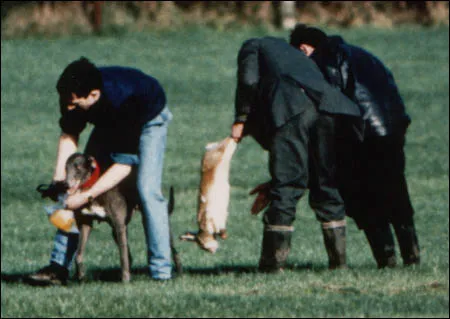
According to the Open Seasons Order (Mammals), hares can be legally hunted with packs of hounds and can be shot from the 26th of September to the 28th February.
Hares cannot be hunted in North East Slob, North West Slob, Big Island, Beggerin Island and The Raven, in Co. Wexford.
Get in Touch
If you have a tip for an animal welfare issue, an animal news article, a press release, or just want to just reach out to us, we’d love to hear from you. John Tierney, Animal News Ireland/Editor
Support Animal Journalism
Dear reader: If you support animal journalism and its work to highlight animal issues, please consider donating to Animal News Ireland. You can give any amount one time, or make it a monthly gift, as many of our supporters do. Thank you for helping us in our work to be the voice of the voiceless.